
TL;DR: Searching for a free multi-carrier shipping app with FedEx and Canada support usually ends in a trade-off. Free shipping apps tend to cover USPS and UPS® only, with US-origin labels. Platforms that add FedEx, Canada Post, and Purolator usually charge a monthly subscription. In 2026, a third structure exists: free-to-start multi-carrier platforms with per-label fees that decrease with volume. This guide explains how each model works, where the gaps appear, and how to evaluate them for US and Canadian sellers.
Key Facts About Free Multi-Carrier Shipping Apps with FedEx and Canadian Support
- “Free” shipping software follows three structures: free single- or dual-carrier apps, paid subscription platforms, and free-to-start multi-carrier platforms with per-label fees.
- Most free shipping apps in the US support USPS and UPS® only, with no FedEx and no Canadian origin.
- Canadian sellers need Canada Post or Purolator access; many US-built shipping tools offer neither.
- FedEx access on shipping platforms typically works through a connected FedEx account rather than platform-level discounts.
- Postage is always paid to the carrier; software fees (subscriptions or per-label fees) are a separate cost layer.
- Cross-border US↔Canada shipping adds customs documentation, so platform support for both origins matters more than carrier count alone.
Read Ahead
If you are searching for a free multi-carrier shipping app with FedEx and Canada support in 2026, you have probably already outgrown your current tool. This guide is for two kinds of sellers. The first loves their free shipping app but keeps hitting the same wall: no FedEx and no Canadian carriers.
The second watches every shipping invoice and wants more carriers to compare—without adding a monthly subscription to do it.
The volume behind that question keeps growing. U.S. retail e-commerce reached $326.7 billion in Q1 2026, up 9.8% year over year (U.S. Census Bureau, May 18, 2026). Both seller types face the same structural question: which shipping software adds FedEx, Canada Post, and Purolator without reintroducing fixed costs?
The answer depends on how “free” is actually built. The sections below break down the three software structures, the US and Canada carrier landscape, the full multi-carrier workflow, and the mistakes that quietly erode margin. Software recommendations come after the fundamentals.
What Counts as a Free Multi-Carrier Shipping App in 2026?

A free multi-carrier shipping app lets sellers compare rates and buy labels from two or more carriers without a monthly subscription. The word “free” hides three different cost structures: truly free apps limited to one or two carriers, subscription platforms with free trials, and free-to-start platforms with small per-label fees. Knowing which structure you are using determines what you pay as volume grows.
Here is how the three structures differ in practice.
Free single- or dual-carrier apps. These charge nothing for the software. The trade-off is carrier coverage — typically USPS only, or USPS plus UPS®, with US-origin labels only. Sellers who need FedEx or Canadian carriers end up running a second tool.
Paid subscription shipping platforms. These support many carriers, including FedEx and Canadian options. The cost is a fixed monthly fee that applies whether you ship 10 orders or 1,000. For low- and mid-volume sellers, the subscription can exceed the postage savings it unlocks.
Free-to-start multi-carrier platforms. These charge no monthly subscription. Instead, a small per-label service fee applies, separate from carrier postage. The software cost scales with what you actually ship.
The structural difference shows up in slow months. A subscription bills the same in January as in December. A per-label fee is the only software cost structure that automatically falls to zero in a month when nothing ships—a subscription cannot do that by design.
One rule applies to all three structures. Postage is always paid directly to the carrier. The software layer — whether subscription or per-label fee — is a separate cost on top of postage, and it should be tracked as its own line.
Why FedEx and Canadian Carriers Are the Two Most Common Gaps

FedEx access and Canadian carrier support are the two features that most often force sellers off free shipping apps. Free apps are usually built around USPS commercial pricing, sometimes with UPS® added. FedEx typically requires a connected account, and Canadian carriers require Canada-origin label support that many US tools never built. Sellers hit these gaps as soon as customers or marketplaces demand them.
The FedEx gap (US and Canada)
FedEx matters for specific shipment profiles. FedEx Home Delivery and FedEx Ground are common requests for residential and B2B shipments, especially for electronics and higher-value goods. Some wholesale buyers and marketplaces specify FedEx for inbound shipments.
On most shipping platforms, FedEx works through a connected account. You link your own FedEx or FedEx Canada account, and your negotiated rates flow into the platform. This is access, not a platform discount — a useful distinction when comparing tools.
The Canadian gap
Canadian sellers need Canada-origin labels, which is a different capability than shipping to Canada. Domestic Canadian coverage runs through Canada Post and Purolator. Canada Post handles the broadest residential coverage, including rural and remote postal codes; Purolator is a strong domestic courier option for time-sensitive parcels.
Cross-border adds a second layer. A seller in Ontario shipping to Buffalo needs customs documentation, HS codes, and a platform that treats Canada as an origin country. A seller in Texas expanding into Toronto needs the reverse — and many shipping tools handle only one direction, or neither.
There is also a currency dimension. Canadian sellers quoting in CAD and buying US postage in USD need both currencies handled cleanly.
The practical result: sellers juggle two or three tools. One app for US-origin USPS labels. A carrier portal for FedEx. A separate Canada Post account for Canadian orders. Fragmentation like this compounds as volume grows — the full e-commerce shipping workflow shows where each handoff leaks time.
The End-to-End Multi-Carrier Shipping Workflow

A multi-carrier shipping workflow runs from order import to delivery confirmation in eight steps. The carrier decision sits in the middle, which is why rate comparison only helps if it happens before the label is purchased. Each step below applies whether you ship from the US, from Canada, or across the border.
| Step | What Happens | US/Canada Nuance |
|---|---|---|
| 1. Order import | Orders pull in from stores like Shopify, eBay, Amazon, WooCommerce, or TikTok Shop | Multi-store sellers need one inbox for all channels, in USD and CAD |
| 2. Packaging | Weight and dimensions are recorded | Dimensional (DIM) weight rules differ by carrier and can exceed actual weight |
| 3. Carrier selection | Rates are compared across available services | US: USPS, UPS®, FedEx. Canada: Canada Post, Purolator, UPS® Canada, FedEx Canada |
| 4. Label creation | The label is purchased; postage goes to the carrier | Cross-border labels add customs forms and HS codes |
| 5. Label printing | Label prints on thermal or standard printer | Thermal printing avoids ink and toner entirely |
| 6. Handoff | Drop-off or scheduled pickup | Pickup availability varies by carrier and region |
| 7. Tracking | Tracking syncs back to the selling channel | Buyers expect tracking regardless of carrier chosen |
| 8. Economics review | Per-shipment costs are reviewed against margin | Software fees and postage should be tracked as separate lines |
Two steps cause the most margin damage when skipped. Step 2, because dimensional weight surprises appear on the invoice, not the quote. And step 3, because a one-carrier tool turns “carrier selection” into “carrier default”—the comparison never happens.
Step 8 is the most commonly missing step entirely. Without a periodic review, sellers cannot see whether their default carrier is still the economical choice.
Common Mistakes When Evaluating “Free” Shipping Software

The most expensive mistakes in choosing shipping software are structural, not tactical. Sellers compare headline prices instead of cost structures, count carriers instead of checking origins, and treat the carrier comparison as a one-time decision. Each of these errors looks small at signup and compounds with every label printed afterward.
Mistake 1: Comparing “free” labels instead of cost structures. Two tools can both say “free” and bill completely differently at 500 orders a month. The right comparison is total software cost at your actual volume.
Mistake 2: Counting carriers without checking origin support. A platform listing “Canada Post” may only support shipping to Canada from the US. Canadian-origin sellers should confirm that domestic Canadian labels can actually be generated.
Mistake 3: Treating the carrier decision as permanent. Carrier rates, surcharges, and fuel fees change throughout the year. Last quarter’s cheapest service may not be this quarter’s, so the comparison should repeat, not retire. For small sellers, how often re-comparison pays off depends on volume and shipment mix—the same logic behind shipping automation for small businesses.
Mistake 4: Ignoring the mobile and hardware workflow. Web-only tools assume a desk. Sellers who pack from a garage, a storage unit, or a live-selling setup lose time on every label without a mobile path.
Mistake 5: Forgetting that postage and software are separate invoices. Discounted postage on one tool can be offset by software fees on another. The only number that matters is the combined per-shipment cost.
Once you understand how these structures, workflow steps, and mistakes stack up, the next question is which platform structure gives you FedEx and Canadian access without taking on a subscription.
Is There a Free Multi-Carrier Shipping App with FedEx and Canadian Carriers?

Yes—free-to-start multi-carrier platforms combine multiple carriers, have no monthly subscription, and have a per-label fee that decreases with volume. Rollo Ship follows this structure: USPS, UPS®, FedEx, Canada Post, and Purolator in one account, available in the United States and Canada. Rollo is not a carrier — postage is always paid directly to the carrier.
Rollo Ship is a free multi-carrier shipping platform, with UPS® Canada and FedEx Canada included for Canadian-origin shipping. It is rated 4.8★ on Capterra. More than 500,000 sellers across the US and Canada use the platform.
The economics work like this. Rollo Ship is free to start, with no monthly subscription. A small per-label service fee applies, starting at 5 cents and decreasing to as low as 1 cent per label through Rollo Rewards — and the first 200 labels are fee-free for new users. In that sense, Rollo is a margin-optimization system for shippers who want their costs to improve as they grow.

The per-label service fee decreases as shipping volume moves a seller through Rollo Rewards tiers:
| Rollo Rewards tier | Per-label service fee |
|---|---|
| Newbie / Basic | 5¢ per label |
| Pro | 3¢ per label |
| Expert | 2¢ per label |
| VIP | 1¢ per label |
Per-label service fee only; carrier postage is separate. The first 200 labels are fee-free for new users.
On rates, by shipping origin. From a U.S. origin, Rollo Ship provides access to discounted USPS rates up to 90% off retail USPS rates on select services, plus discounted UPS® rates.
Discounts off UPS daily rates. Rates are limited to shipping from the U.S. only. Rates and any applicable discounts are subject to change at any time without notice.
From a Canadian origin, Canada Post rates are discounted up to 34% on domestic services and up to 58% on international, across 16 Canada Post services with no contract or volume requirement. UPS® is discounted on every Canadian lane — up to 76% off UPS Standard® within Canada, and up to 76% off UPS Express®, UPS Express Saver® and UPS Expedited® from Canada to the United States.
Discounts off UPS daily rates. Rates are limited to shipping from Canada only. Rates and any applicable discounts are subject to change at any time without notice. Inclusive of applicable fuel and residential surcharge. Not including other additional applicable charges and taxes. UPS® services and discounted rates shown are for shipments originating in Canada.
FedEx and FedEx Canada work through a connected account—you link your own FedEx account, and your rates appear alongside the other carriers for comparison. Canada Post and Purolator are integrated as domestic Canadian carriers with commercial platform access, covering both domestic Canadian and cross-border workflows.
Rate selection itself is assisted. Rollo Ship’s AI-powered rate selection groups similar orders, applies the seller’s shipping rules, and recommends the cheapest service before the label is printed. For the seller who scrutinizes every invoice, that means the comparison happens at step 3 of the workflow — before money leaves the account, not after.
The platform also closes the mobile and multi-store gaps from the mistakes list above. Rollo Ship runs on web, native iOS, and native Android apps, so labels can be created and printed away from a desktop. Free bundled inventory management tracks stock across multiple stores in USD and CAD.

Scenario 1: The US seller whose customers want FedEx
Consider an eBay and Shopify seller in Michigan shipping a few hundred orders a month on a free USPS-and-UPS®-only app. Half their new wholesale customers request FedEx Ground. Inside their current tool, that request is unservable; outside it, it means a separate FedEx portal and manual reconciliation.
In Rollo Ship, the same seller connects their FedEx account once. FedEx rates then appear in the same comparison screen as USPS and UPS®, and the order still imports, prints, and tracks through the same workflow. Nothing about the simple process they liked has to change—the carrier list grows, the workflow does not. See how FedEx access works on the free plan.
Scenario 2: The Canadian seller running two systems
Now consider a WooCommerce seller in Ontario. Domestic orders go through a Canada Post account; cross-border orders to US buyers run through a separate US-focused tool that treats Canada as an afterthought.
In Rollo Ship, Canada Post and Purolator quotes sit next to UPS® Canada and FedEx Canada on one screen. Cross-border labels carry the customs documentation in the same flow, and US-bound and domestic orders reconcile in one place. See the free multi-carrier shipping platform for the full carrier and workflow breakdown.
Print the Label Without Slowing Down the Workflow
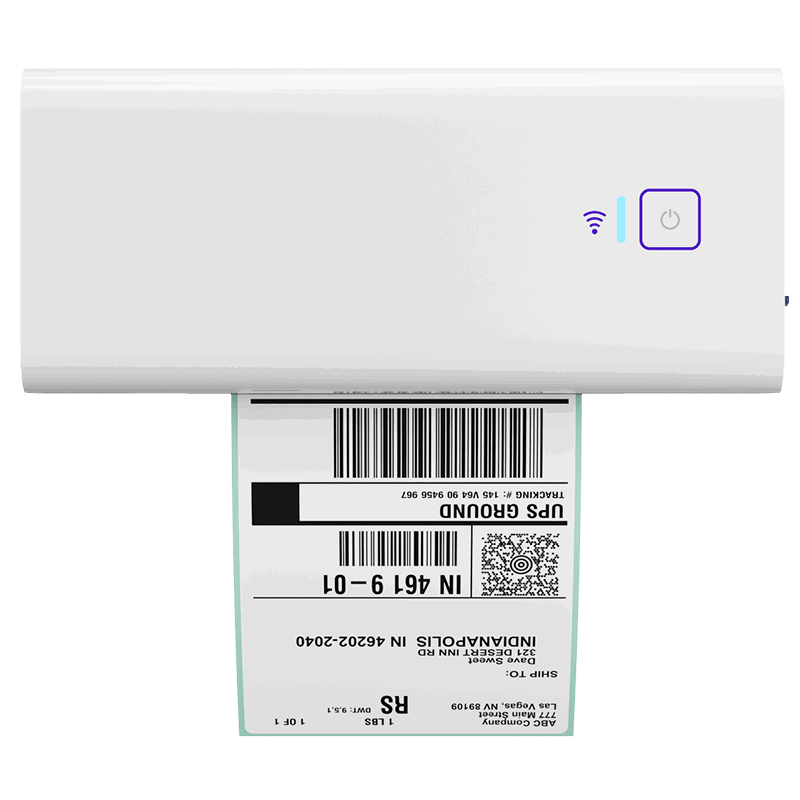
Step 5 of the workflow is where thermal printing earns its place—it
avoids ink and toner entirely, so labels never stall on a low cartridge.
The Rollo Wireless Printer (X1040) prints crisp 4×6 labels wirelessly,
keeping the packing station moving once the carrier is chosen.
For sellers tired of jam-prone laser printers, it removes the last
friction point between buying the label and getting the parcel out the door.
What Happens Without a System Like This

Without a multi-carrier structure, the costs are operational before they are financial. Carrier comparison happens manually, in separate tabs, against retail rate cards that do not reflect commercial pricing. Most sellers stop comparing within a few weeks and default to one carrier.
Fragmentation follows. US orders run through one app, FedEx shipments through a carrier portal, and Canadian orders through another account. Each system holds part of the tracking picture, and none holds the full cost picture.
The data cost is quieter but real. When shipment history is split across systems, step 8 of the workflow — the economics review — becomes impractical.
Subscription platforms solve the fragmentation but invert the economics. The fixed fee is constant whether volume rises or dips, so slow months carry the same software cost as peak months. None of this is dramatic—it is a steady drag: minutes per order, untracked surcharges, and a software bill disconnected from shipping activity.
Who This Is NOT For

A multi-carrier platform is a structural fit, not a universal one. If you ship a handful of one-off parcels per year, carrier-native tools like the Canada Post website or USPS Click-N-Ship are likely sufficient. The comparison advantage only compounds with recurring volume.
It is also not a fit if a 3PL controls your label creation. When a fulfillment partner buys postage on your behalf, the carrier decision is theirs, and shipping software sits outside your workflow.
Finally, sellers locked into a single negotiated carrier contract may see limited comparison value until that contract renews. For everyone in between—sellers printing their own labels across US or Canadian carriers—the multi-carrier structure is where the economics improve.
When to Try Rollo Ship
If your free shipping app cannot produce a FedEx label or a Canadian-origin label, that is the structural signal—the limitation is the tool’s carrier architecture, not your workflow. Outgrowing a free app does not require graduating into a subscription.
For the seller who loved the simplicity of a free app, Rollo Ship keeps the friction-free model—free to start, no monthly fee—and adds FedEx, Canada Post, and Purolator alongside USPS and UPS®, plus iOS and Android apps for shipping away from the desk.
For the cost-focused seller: every label shows the real cost across carriers before purchase, the per-label fee starts at 5 cents, and Rollo Rewards lowers it to as low as 1 cent as volume grows. The first 200 labels are fee-free, so the structure can be tested at zero software cost.
Rollo Ship is the free multi-carrier shipping platform built for exactly this transition—one account covering US and Canadian carriers, with software costs that shrink as you ship more. Sign up for Rollo Ship at ship.rollo.com and run your next 200 labels fee-free.
Make Cross–Border Shipping Easier to Repeat
If you are tired of bouncing between tabs, second-guessing label choices, and dealing with surprise-fee fallout later, Rollo Ship gives you one place to compare rates, manage label flow, and make clearer shipping decisions before you buy.

Follow Rollo on:
Frequently Asked Questions About Free Multi-Carrier Shipping Apps with FedEx and Canadian Support
📌 Q: Is there a free shipping app that includes FedEx?
💭 A: Most free shipping apps support USPS and UPS® only. FedEx access on shipping platforms generally works through a connected FedEx account rather than built-in discounts. Free-to-start multi-carrier platforms like Rollo Ship support FedEx and FedEx Canada via connected account, alongside USPS, UPS®, Canada Post, and Purolator, with no monthly subscription.
📌 Q: Can Canadian sellers use free multi-carrier shipping software?
💭 A: Yes, but only on platforms that support Canada as an origin country. That requires Canada Post or Purolator integration and Canadian customs documentation for cross-border orders. Many US-built free apps offer US-origin labels only. Rollo Ship supports both US and Canadian origins from one account, including Canada Post and Purolator.
📌 Q: Can I integrate a multi-carrier shipping app with my existing online store?
💭 A: Most multi-carrier platforms connect to common selling channels so orders import automatically. Rollo Ship offers 16+ live integrations, including Shopify, eBay, Amazon, WooCommerce, TikTok Shop, Squarespace, and Wix. Orders from multiple stores land in one dashboard, in USD or CAD, where rates can be compared before labels are purchased.
📌 Q: What features should I look for in a multi-carrier shipping app?
💭 A: Look at four things: carrier coverage in your origin country, the cost structure (subscription versus per-label fee), store integrations, and whether rate comparison happens before label purchase. Mobile apps and inventory support matter for sellers working across multiple channels. A multi-carrier platform like Rollo Ship covers these in one free-to-start account.
📌 Q: Does a free shipping platform mean free postage?
💭 A: No. Postage is always paid directly to the carrier, on every platform. “Free” refers to the software layer—no monthly subscription. Rollo Ship charges a small per-label service fee, starting at 5 cents and decreasing to as low as 1 cent through Rollo Rewards, separate from carrier postage.
📌 Q: What shipping software works for Canadian sellers without a subscription?
💭 A: Canadian sellers need software that supports Canada as an origin country, with Canada Post and Purolator integration for domestic coverage. Most free shipping apps are US-origin only, and most Canada-capable platforms charge a monthly subscription. Rollo Ship offers Canadian-origin labels across Canada Post, Purolator, UPS® Canada, and FedEx Canada, free to start with no monthly fee.
📌 Q: How does cross-border shipping between the US and Canada work on a shipping platform?
💭 A: Cross-border parcels require customs documentation, including declared values and HS codes, generated alongside the label. A platform that supports both origins produces the correct forms for either direction. Rollo Ship handles US-origin and Canada-origin labels in one account, so cross-border sellers avoid maintaining separate tools for each side of the border.


