
TL;DR: Poster shipping comes down to a format choice: a rigid tube, a flat rigid mailer, or a box. The right one depends on the print, the deadline, and the carrier's size rules. Long tubes can trigger length fees before weight ever matters. Trade show jobs split in two—parcel-shippable tubes and banners versus crated booths that need freight. This guide covers packing, poster box shipping, carrier rate comparison, and hitting event dates across the US and Canada.
Poster Shipping At a Glance
- Rolled prints ship three ways: in a rigid tube, flat between rigid boards, or boxed. Each guards against a different kind of damage.
- A long tube can trigger a carrier length or additional-handling charge before weight is counted.
- Trade-show shipments split: tubes and banner rolls go by carrier; crated booth walls on a pallet go by freight.
- Date-specific campaigns fail on transit time, not just price. The ship-by date drives the carrier choice.
- Comparing carriers matters most when one carrier’s oversize rule fires and another’s does not.
- The US and Canada differ. Canada Post and Purolator cover domestic Canada; cross-border prints add customs.
Table of Contents
Who this guide is for

This guide is for the teams shipping short-run, date-critical large-format work. That means public relations agencies, creative and branding studios, and graphic design shops. It also means print services and custom print businesses and signage and display teams. The print is rarely the hard part. The ship-by date is. Poster shipping, done well, protects both the print and the deadline across the US and Canada.
The work looks different by team, but the shipping problem rhymes.
A PR agency sends press kit posters to reviewers before an embargo lifts. A branding studio ships campaign banners to a client’s launch event. A signage and display team routes trade show graphics to a convention hall on a fixed move-in date. A custom-print shop mails limited runs to buyers who paid for a specific arrival window. In every case, the same three levers apply: the format, the packing, and the carrier’s size rules.
How poster shipping actually works: tube, flat, or box

Poster shipping uses one of three methods. A rigid tube protects a rolled print from crushing and is compact to send. A flat rigid mailer keeps the print uncreased and suits work that you should not roll up. A box, with corner protection, handles framed or mounted pieces. Tubes fit most rolled paper and vinyl. Flats fit thin, mounted prints.
Rolling has a limit. Thick stock and laminated prints resist tight rolls and can crack. For those, flat or boxed wins. Thin paper posters roll easily and travel well in a tube. Match the method to the print, not to habit.
Poster box shipping deserves its own note. A box is the safest option for a framed or foam-mounted piece. It is also the heaviest and the most dimensional. That trade-off matters when you compare rates later. Reach for a box when protection outranks cost and for a tube or flat when the print can take it.
| Format | Suited to | Protects against | Watch-out |
|---|---|---|---|
| Rigid tube | Rolled paper/vinyl posters, banner rolls | Crushing, edge dents | Length can trigger a size/handling fee |
| Flat rigid mailer | Prints you can’t roll, thin mounted work | Creasing, folding | Larger flats raise dimensional cost |
| Boxed (poster box shipping) | Framed, mounted, or heavy stock | Impact, corner damage | Heaviest, most dimensional option |
Why do large-format prints cost more than they weigh?

A poster weighs almost nothing. It can still be priced like a big parcel. Carriers bill long or bulky items by dimensional weight and by handling, not by scale weight alone. Dimensional weight, or DIM, converts a package’s size into a billable weight. A long, light tube can bill as if it were far heavier.
There is a second cost layer. Carriers add handling fees when a package crosses certain length or size limits. A tube a few inches too long can jump a fee tier. That is why two tubes of the same weight can price differently. Measure the packed length before you choose a carrier.
| What triggers it | Verified USPS threshold | Why it hits poster tubes |
|---|---|---|
| Dimensional-weight pricing | Package over 1 cubic foot (1,728 cu in) | A long tube with empty ends bills on size, not actual weight |
| Nonstandard length fee | 22–30 inches, then a higher fee over 30 inches | Most poster and banner tubes clear 22″; many clear 30″ |
| Cylindrical-shape fee | Applies to tubes and rolls specifically | A round tube can trigger it; only the higher of shape-or-length applies |
| Oversized pricing | 108–130 inches combined length + girth (Ground Advantage) | Wide, long trade-show tubes hit this and price by the oversized tier |
| Maximum size | 108 inches combined length + girth standard; 130 inches Ground Advantage; over 130″ is nonmailable | Full-height graphics can exceed the limit entirely |
| Maximum weight | 70 pounds | Boxed or framed large-format pieces |
USPS thresholds above reflect published rates effective July 12, 2026, in USPS Notice 123. Carrier fees change; confirm current dimensions against USPS size guidelines before you commit.
Those are USPS’s numbers. Other carriers set their own limits, and they do not line up. That mismatch is why the same tube can ship clean on one carrier and trigger a fee on the next.
Picture two shipments of the same poster. One goes in an oversized tube with empty space at the ends. The other goes in a tube cut close to the rolled print. The second can be priced lower because dimensional weight rewards a tighter package. The print did not change. The packed size did.

The lesson is practical. Sometimes a shorter tube changes the price more than a lighter print does. Trim the tube to the print. Small-size decisions move the invoice.
Can you ship a poster tube with USPS?

USPS poster tube shipping is a common starting point for smaller runs. The U.S. Postal Service (USPS) ships rolled posters as parcels, priced by size, weight, and destination zone. For light posters over shorter distances, USPS is often a practical option.
Watch two things with USPS. Long or rigid tubes can attract an extra handling surcharge on top of the base rate. And a very long tube can run into USPS size limits. Both affect the price or the eligibility. It helps to check the packed dimensions against current USPS guidelines before you commit.
For valuable prints, add tracking and insurance. A limited-run event poster is expensive to reprint. Tracking confirms delivery before the show. Insurance covers the print if it is lost or crushed. Both are worth the small add-on on date-critical work.
USPS is not always the answer. As tubes get longer, heavier, or more urgent, another carrier can price lower or deliver faster. That is the moment to compare, not assume. The next section covers the two carriers that usually enter the picture for larger tubes.
UPS® vs FedEx for large packages

UPS® vs. FedEx for large packages is the next question once a tube outgrows a basic mail service. Both carriers handle large parcels. Both apply additional handling and oversize rules based on length and size. Neither is automatically the right pick. The answer changes shipment by shipment.
Here is why comparison matters. One carrier’s length threshold may sit an inch below your tube, adding a fee. Another may sit above it, so the same tube ships clean. The only way to know is to price the exact packed dimensions on both. On large-format work, that gap is real money.
So the takeaway is not “pick one.” It is “compare per shipment.” Rates and rules shift. Price both against the packed size every time, and comparing in one place is what turns that variable into a decision.
Comparing carrier rates for posters and banners in one place

Comparing carrier rates for posters means pricing the exact packed dimensions across every available carrier before you buy the label. Done manually, that is three or four portals per tube. A multi-carrier shipping platform puts the same comparison on one screen, so the oversize rule that fires on one carrier and not another is visible before you commit.
On a deadline, that is where time and money leak. Rollo Ship is a free multi-carrier shipping platform built for exactly this. It connects five carriers in one account: USPS, UPS®, FedEx, Canada Post, and Purolator.
FedEx is available through connected-account access. That range matters for large-format work, because when one carrier’s oversize rule fires on a long tube, another may price it lower.
Rollo Ship is a free multi-carrier shipping platform built for exactly this. It connects five carriers in one account: USPS, UPS®, FedEx, Canada Post, and Purolator. FedEx is available through connected-account access. That range matters for large-format work, because when one carrier’s oversize rule fires on a long tube, another may price it lower.
The workflow fits how orders actually arrive. The job might come from a Shopify storefront, a Best Buy marketplace listing, a Whatnot drop, or a direct client PO. Either way, the shipping step is the same. Rollo Ship connects with the stores and marketplaces sellers already use, including Shopify, Amazon, eBay, WooCommerce, TikTok Shop, and Best Buy. Orders flow in; you rate-compare and print without re-keying.
Here is the concrete case. A creative agency ships 40 event posters in tubes and 6 retractable banners on a Friday for a Tuesday show. Rollo Ship’s AI-powered rate selection groups similar orders, applies the seller’s shipping rules, and recommends the lowest-priced qualifying service before the label is printed.
The platform runs on native iOS, native Android, and the web, so the shop can rate-shop from the packing bench. For a Canada-origin job, the same account covers domestic Canada and the cross-border lane. Setup for that market lives on the Rollo Canada page, with carrier details on the Canada Post page.

Two facts worth stating plainly. Rollo Ship holds a 4.8-star rating on Capterra. More than 500,000 sellers across the US and Canada ship on Rollo. Rollo is not a carrier. Postage is paid directly to the carrier; Rollo’s per-label fee is separate.
On price, Rollo Ship is free to start with no monthly subscription. New users get their first 200 labels with no per-label fee. After that the fee starts at 5¢ and drops to as low as 1¢ through Rollo Rewards. The multi-carrier approach applies well beyond posters, and the same logic covers fragile large-format work like art.
Shipping trade show materials on a deadline

Shipping trade show materials splits into two very different jobs. Most teams miss this and overpay. The tubes of posters, the retractable banners, and the rolled backdrops all ship by carrier as parcels. The crated booth walls and heavy displays ship by freight, or LTL (Less-Than-Truckload), on a pallet. Treating the whole load as one shipment is where budgets break.
Separate the two before you book. Parcel-ship the tubes and banners. Freight only the pallet. This one split often saves more than any single rate choice.
Deadlines change the math again. Venues enforce move-in windows and charge for late or early arrivals. So the ship-by date, not the label price alone, drives the carrier choice. A slower service that misses the window costs more than a faster one. For event calendars, work backward from each venue’s receiving date.
Build a simple buffer into that date. Count the transit days, then add a margin for weather, customs, or a missed pickup. Ship early enough that a one-day slip does not become a no-show. For a season of back-to-back events, a shared calendar of ship-by dates keeps every booth on time.
How do you ship a banner without creasing it?

Banner shipping follows the same logic as posters, with one twist. Vinyl and fabric banners crease if folded, and creases show on camera. Roll them, never fold them. A wide tube or a rolled-and-boxed method keeps the surface clean.
Retractable banner stands add weight and rigidity. The stand is a hard, dense item; the banner is soft. Pack the stand so its edges cannot press into the banner. For a set of stands, a box with internal separation beats a single loose tube. Match the pack to the hardware, not just the print.
Tube diameter matters for banners too. A wide tube lets the banner coil in a gentle loop instead of a tight curl. A tight curl can set a curve into vinyl that shows when the banner hangs. Give the roll room, and it relaxes flat on-site.
US vs Canada: shipping posters across the border

Shipping posters inside Canada and across the border follow different rules. Within Canada, Canada Post and Purolator handle tubes and large parcels, each with its own size limits. Domestic Canada pricing and transit differ from the US. Plan according to the Canadian carrier’s rules, not the US ones.
Cross-border adds a customs step. Commercial prints crossing the US–Canada border need a customs declaration and the right product codes. Customs can add transit days. For a fixed event date, build that buffer in. The border is a schedule risk, not just a cost.
Once the format and the ship-by date are set, the carrier is the last variable. Comparing rates in one place is what turns that variable into a decision.
For a Canada-origin run, the same Rollo Ship account covers domestic Canada and the cross-border lane. Canada Post and Purolator sit alongside the US carriers, so a print heading to Toronto and one heading to Chicago are rate-compared on the same screen. Setup lives on the Rollo Canada page.
Make Cross–
Border
Shipping
Easier
to Repeat
If you are tired of bouncing between tabs, second-guessing label choices, and dealing with surprise-fee fallout later, Rollo Ship gives you one place to compare rates, manage label flow, and make clearer shipping decisions before you buy.

A poster-shipping workflow, start to finish

A repeatable workflow keeps date-critical runs on time. The steps below hold whether you ship one poster or forty. Build them into the process once, then run them per shipment.
| Step | What happens | Why it matters |
|---|---|---|
| 1. Order in | Pull the order from a store, marketplace, or client PO | One source of truth, no re-keying |
| 2. Measure packed size | Measure the tube or box as packed, not the print flat | Size drives the price and the fee tiers |
| 3. Choose the format | Tube, flat, or box, matched to the print | Protection and cost are set here |
| 4. Compare carriers | Price the exact dimensions across carriers | One carrier’s oversize rule may not fire |
| 5. Print the label | Buy the service that meets the ship-by date | The date, not the price alone, decides |
6. Track to the venue | Confirm delivery before the event | Catches delays while there is still time |
Follow the same six steps every time. The discipline is what prevents the last-minute reprint. For a full event calendar, run the sequence per shipment and work backward from each venue’s receiving date.
Print the Label Without
Slowing Down the Workflow
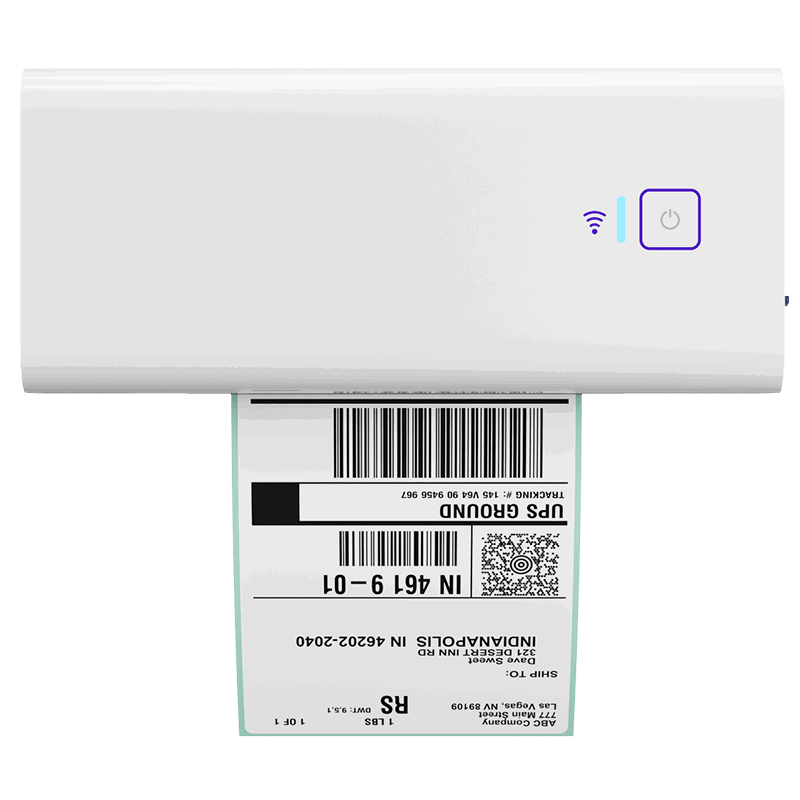
Once you know which shipping path makes the most sense, the next step should feel simple. The Rollo Wireless Printer (X1040) helps you print crisp 4×6 labels quickly, so your packing station keeps moving without adding extra friction to the order.
What happens without a system like this

Picture the week of a show with no way to compare before you print. A tube slips past a carrier’s length limit, and the oversize fee lands after you’ve already committed. A banner goes out on a service that misses the venue’s move-in window, so it reprints on the floor at rush pricing. The reorder eats the margin the job was supposed to earn.
None of that is the postage. It is the leakage around it. Surprise size fees, blown ship-by dates, and reprints that cost more than the original run. For a shop juggling date-specific campaigns, one slip repeats across every show on the calendar. Seeing every carrier’s rate on one screen, before the label prints, is what closes the gap.
Ready to ship your next run?

Once the format and the ship-by date are set, the carrier choice is the last lever. Rollo Ship is the platform that puts that choice on one screen—five carriers, US and Canada, rate-compared before the label prints. Start free, keep your first 200 labels fee-free, and rate-shop your next poster or banner run in one place. Create your free Rollo Ship account.
Who this is NOT for
This guide is built for operators shipping short-run, date-critical large-format work. It is not for a few cases. If you are shipping a single poster you bought online, a consumer carrier drop-off is simpler than a platform.
If you need full freight, LTL, or drayage for palletized booth structures, that is a freight broker’s job, not a parcel platform’s. If your question is how to design or print a poster, this is about shipping it, not making it. Rollo Ship is a shipping platform, not a printer or a returns system.
Follow Rollo on:
Frequently Asked Questions About Poster Shipping
📌 Q: Should posters ship in a tube, flat, or a box?
💭 A: It depends on the print. A rigid tube protects rolled paper and vinyl and is compact to send. A flat rigid mailer suits thin prints you cannot roll. Poster box shipping is safest for framed or mounted pieces, though it is the heaviest and most dimensional option. Match the method to the print.
📌 Q: What’s the cheapest way to ship posters?
💭 A: There is no single answer. The cost changes with size, distance, and deadline. The reliable method is to compare carriers for the exact packed dimensions, then pick the least expensive service that still meets the date. A multi-carrier platform makes that comparison in one step.
📌 Q: How do I keep a poster from bending in the mail?
💭 A: Match the packing to the format. For a tube, roll the print loosely with the image facing in, add end caps, and use a tube wide enough to avoid a tight roll. For flat prints, sandwich them between two rigid boards. The goal is a package that will not flex under normal handling.
📌 Q: Does a poster tube cost more to ship because it is long?
💭 A: It can. Carriers price long items by dimensional size and handling, not weight alone, so a tube can cross a length threshold that adds a fee. Measure the packed length before choosing a carrier. A shorter tube may sit under a fee tier and price lower for the same print.
📌 Q: Is USPS poster tube shipping a good option?
💭 A: For light posters over shorter distances, it often is. USPS ships rolled posters as parcels. Watch for extra handling surcharges on long or rigid tubes and for USPS size limits, both of which can change the price or eligibility. For valuable prints, add tracking and insurance before an event date.
📌 Q: Can I ship posters and banners into or from Canada?
💭 A: Yes. Inside Canada, Canada Post and Purolator handle tubes and large parcels within their size limits. Cross-border prints between the US and Canada need a customs declaration and correct product codes, which can add transit days. Build that buffer into any event timeline.
📌 Q: How do I compare UPS® vs. FedEx for a large poster tube?
💭 A: Price the exact packed dimensions on both. Each applies additional handling and oversize rules by length, and the thresholds differ. A tube that triggers a fee on one may ship clean on the other. Comparing per shipment is the reliable way to find the lower rate.


