
Shipping discounts for small business are reduced carrier rates that help online sellers lower delivery costs without needing enterprise-level shipping volume. They can come from carrier programs, negotiated accounts, promotional offers, or shipping software that lets sellers compare available rates from multiple carriers in one place.
“You spent $12 shipping a $20 order? That’s half your profit gone.” If this sounds familiar, you’re not alone. For e-commerce sellers, a shipping discount can be the difference between scraping by and scaling up.
For small businesses, those savings can change the math on every order. Lower shipping costs can make free shipping thresholds more realistic, help protect margins, and give customers fewer reasons to abandon checkout. The USPS Office of Inspector General describes merchant rate programs as a way to support small and midsize businesses with discounted parcel rates through third-party shipping platforms that let merchants compare package options by weight, size, and delivery timing.
In this guide, we’ll break down how shipping discounts work, where to find them, how U.S. and Canadian sellers can compare carrier options, and how tools like Rollo Ship help small businesses compete with larger retailers.
Article Highlights
What are shipping discounts for small business?
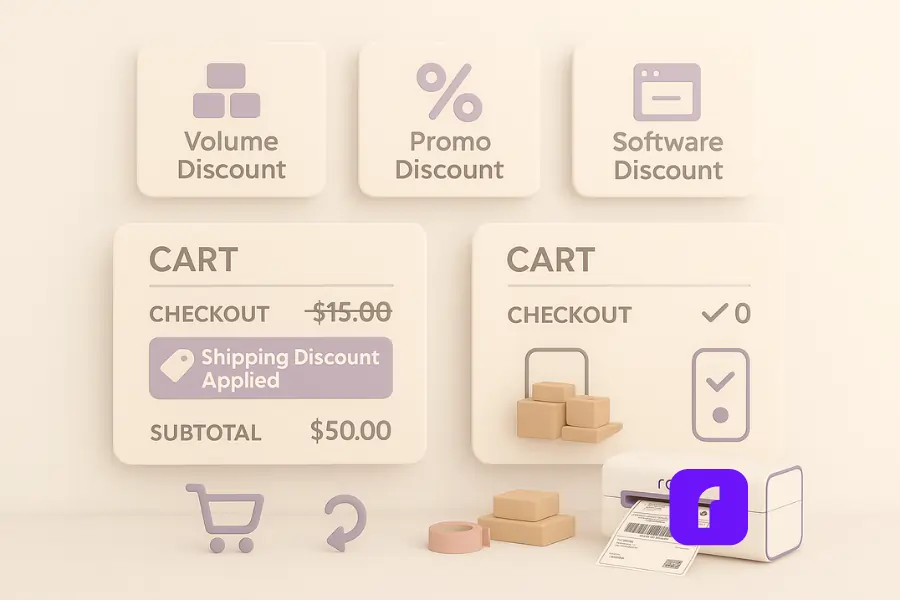
Shipping discounts for small business are reduced shipping rates that help sellers pay less than standard retail prices for eligible shipments. These discounts may come from carrier programs, negotiated accounts, promotional offers, or shipping software that gives sellers access to available rate options without requiring high monthly volume.
For many small businesses, shipping is not just a fulfillment expense. It affects product pricing, customer experience, conversion rates, and repeat purchases. A seller shipping $18 accessories, $35 skincare bundles, or $60 handmade goods needs shipping costs to stay predictable enough to protect profit.
Common types of shipping discounts
Most sellers unlock savings in three ways—here’s how each one works at a glance.
| Discount Type | How It Works | Best For |
|---|---|---|
| Volume discounts | Price tiers kick in as shipping volume grows. | Established sellers with predictable order volume |
| Promotional or select service discounts | Limited-time or service-specific discounts apply to certain shipping options. | Sellers running seasonal campaigns or testing delivery options |
| Aggregator or software discounts | Shipping platforms help sellers access available discounted rates and compare carriers in one workflow. | Small and midsize sellers that want flexibility without negotiating separately |
If you don’t meet carrier thresholds, use software like Rollo Ship to compare available discounted rates and keep shipping costs competitive from your first shipment.
How shipping discounts boost sales
Shipping discounts help e-commerce sales by lowering one of the most visible costs customers see at checkout. When sellers reduce delivery costs, they can create more realistic free shipping thresholds, offer reduced shipping promotions, protect product margins, and compete with larger retailers without lowering product prices.
The goal is not always to offer the lowest possible shipping price. The better goal is to make shipping feel fair, predictable, and aligned with the customer’s order value.
Which carriers offer the best shipping discounts?
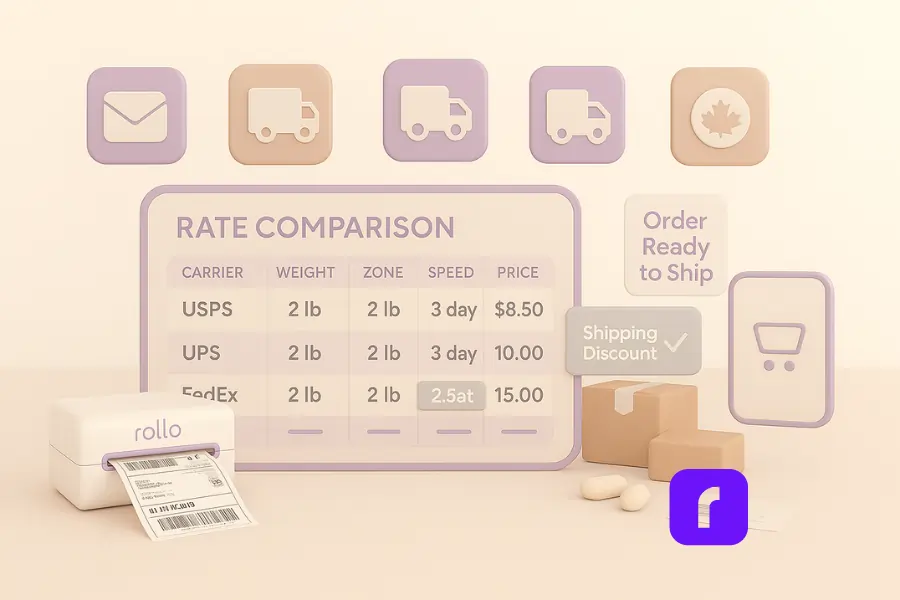
There’s no one “best” carrier for every seller. The best shipping discounts vary depending on weight, dimensions, zones, speed, residential delivery, pickup needs, and whether the shipment is domestic or cross-border. USPS can be strong for lightweight parcels, UPS can work well for heavier ground shipments, FedEx can be useful for time-sensitive deliveries, and Canada Post or Purolator may matter for Canadian routes.
| Carrier | Often Useful For | What to Watch |
|---|---|---|
| USPS | Lightweight parcels, small packages, residential delivery, PO boxes, apparel, accessories | Service availability, package size, delivery speed |
| UPS | Heavier parcels, dense boxes, ground shipments, business addresses | Accessorial fees, residential delivery, package profile |
| FedEx | Time-sensitive shipments, larger parcels, business deliveries, international options | Surcharges, service-level differences |
| Canada Post | Canadian domestic shipments and cross-border options | Regional pricing and service speed |
| Purolator | Canadian business shipments and select cross-border routes | Lane-specific pricing and pickup availability |
USPS (United States Postal Service)
Sellers can access USPS shipping discounts through Commercial Pricing or via shipping platforms like Rollo Ship that help compare available rate options.
- 📦 Strengths: Affordable USPS services for light parcels, PO boxes, residential delivery, and nationwide reach.
- 💸 Discount path: USPS commercial pricing via platforms; still better than retail rates at the post office.
- 🛍️ Best for: Apparel, cosmetics, DTC accessories, and other sub-5 lb shipments.
For e-commerce sellers moving a steady stream of small packages, USPS often provides the most reliable balance of cost and convenience.
UPS
When your orders skew heavier or you need detailed tracking, UPS can be a smart option to compare. Its ground services can work well for dense boxes, business addresses, and larger parcels, but the best choice still depends on package size, destination, delivery speed, and any applicable fees.
- 📦 Strengths: Ground shipments, tracking visibility, and heavier parcels.
- 💼 Discount path: Negotiated carrier accounts or shipping software access; review fees carefully.
- 🏢 Best for: Heavier products, dense packaging, equipment, and business deliveries.
If you ship weighty items or bulk cartons, compare available UPS services against other carrier options before buying the label.
FedEx
If speed is the name of the game, FedEx should be on your radar. They’re known for reliable time-definite services and broad international reach.
- 🚀 Strengths: Overnight shipping, FedEx Ground, and flexible international shipping via a FedEx account.
- 💸 Discount path: Contracted or aggregator discounted rates; compare surcharges carefully.
- ⏱️ Best for: Time-sensitive or premium delivery promises.
When deadlines matter and your customers expect fast delivery, FedEx often provides the best mix of speed and service.
Purolator & Canada Post
If you’re shipping to or within Canada, these two carriers should be on your shortlist.
- 🇨🇦 Strengths: Purolator offers strong Canadian coverage and solid U.S.–Canada cross-border options. Canada Post excels for domestic Canadian deliveries and also supports cross-border e-commerce.
- 🧭 Tip: Rate shop specific lanes—performance and price can flip by corridor.
Run both through your rate shop to confirm the best deal by weight, zone, and service speed.
For Canadian sellers, this comparison matters because e-commerce remains a meaningful part of retail. Statistics Canada reported that retail e-commerce sales reached $4.0 billion in November 2025, accounting for 5.7% of total retail trade. If you ship within Canada or between the U.S. and Canada, compare the actual lane instead of assuming one carrier wins every time.
Pro Tip: Don’t guess. Compare rates across multiple carriers for every shipment and let software pick the best deal automatically.
How do small businesses qualify for discounted shipping rates?
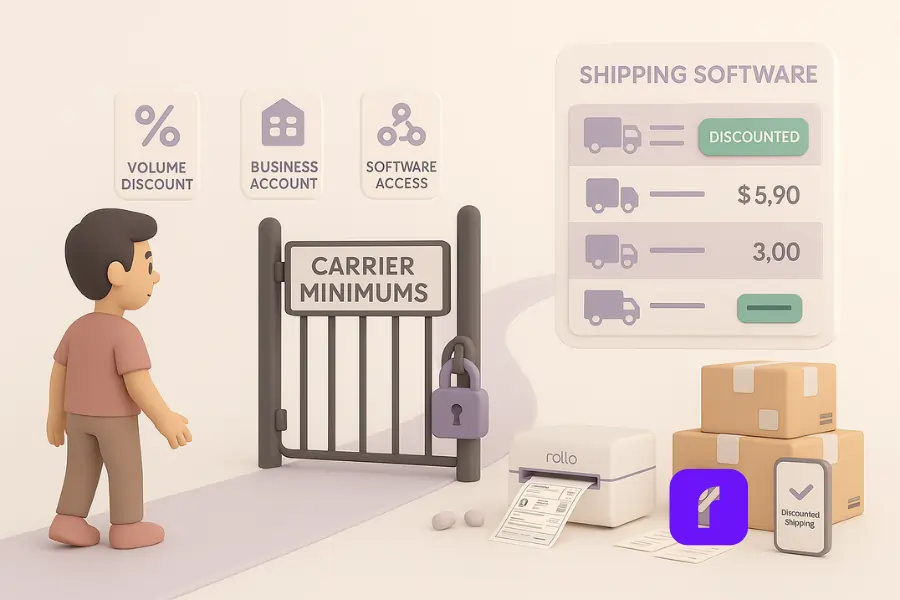
Small businesses can qualify for discounted shipping rates through volume discounts, negotiated carrier accounts, or shipping software that provides access to available discounted rates. If a seller does not have enough volume to negotiate directly, shipping software can be the simpler way to compare discounted options from multiple carriers.
Traditional carrier pricing can reward volume, but many small businesses do not ship enough packages to unlock deeper account-based pricing on their own. That creates a common problem: the seller needs shipping savings before they are large enough to qualify for the strongest direct-account rates.
| Path | How It Works | Main Advantage | Main Limitation |
|---|---|---|---|
| Retail counter rates | Buy postage directly at standard retail pricing | Simple | Usually not cost-efficient for frequent sellers |
| Direct carrier account | Open an account and negotiate based on volume/profile | More control at scale | May require volume consistency |
| Shipping software | Compare available discounted rates inside one platform | Easier access and less manual work | Seller should still compare service details |
Carrier thresholds, short and sweet
Most carriers want proof that you’re serious before they hand out their deepest discounts.
- 📊 Real contracts often ask for consistent weekly volume and service mix.
- ⚖️ Discounts can slide if your shipment profile changes (weight, zone, services).
In short, hitting the right numbers matters—but it’s also why many small sellers lean on software for flexibility.
SMB workarounds
If you’re not shipping thousands of packages, don’t worry—there are practical ways around carrier minimums.
- 🖥️ Use a platform that passes along discounted shipping rates without quotas.
- 📦 Split lanes: USPS for small/light, UPS or FedEx for heavy/oversized.
- 🔧 Set rules: map weight/zone to a service to avoid overpaying.
These simple tactics help smaller operations stay competitive and keep shipping costs predictable.
Is shipping software better than direct carrier accounts?
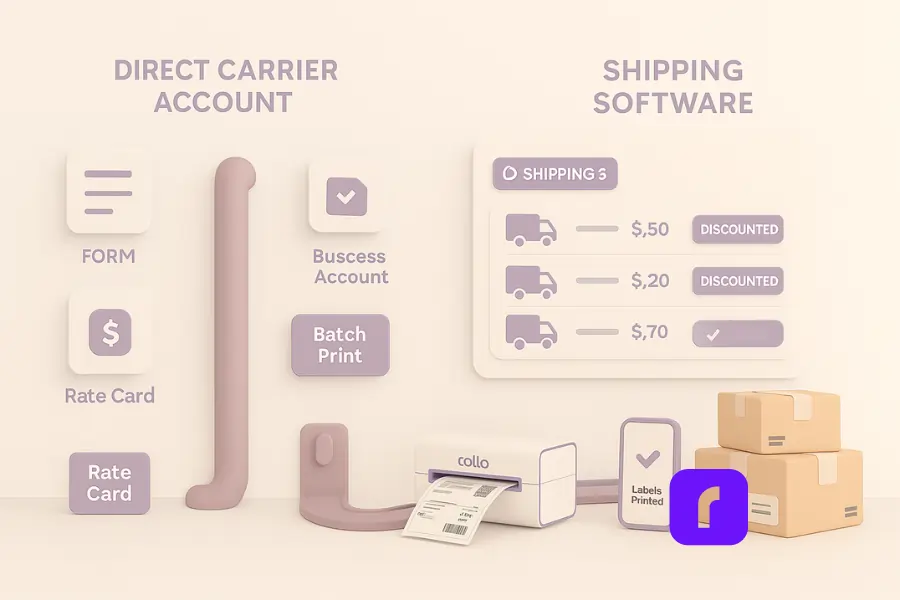
For many small and midsize e-commerce sellers, shipping software is better than relying only on direct carrier accounts because it combines rate comparison, label creation, automation, tracking, and batch printing. Direct accounts can still make sense for high-volume shippers, but software gives smaller sellers more flexibility.
A direct carrier account may work well if your business has consistent volume, predictable package sizes, and a strong understanding of surcharges. But many SMBs ship a mix of orders: a 6 oz hat today, a 3 lb skincare bundle tomorrow, and a 15 lb equipment box next week. That variety is where rate comparison matters.
| Feature | Direct Carrier Account | Shipping Software |
|---|---|---|
| Rate comparison | Usually limited to that carrier | Compare multiple carriers in one place |
| Volume requirement | May matter for stronger pricing | Often easier for smaller sellers to start |
| Label printing | Carrier-specific workflow | Centralized label workflow |
| Automation rules | Varies by account/tools | Often built into the platform |
| Store integrations | May require extra tools | Often connects with e-commerce platforms |
| Best for | Larger shippers with predictable carrier needs | SMBs that want flexibility and simplicity |
Direct carrier accounts: pros & cons
Thinking about going straight to the carrier? Here’s the quick reality check.
- ✅ Pros: Control, known terms, dedicated rep at scale.
- ⚠️ Cons: Hard to qualify, harder to maintain. Discounts may not beat pooled, pre-negotiated software pricing.
If you already ship big volumes, direct can work. If not, you’ll likely save more by pooling volume through software.
Software advantages
Most SMBs get better pricing and far less busywork by letting software handle the heavy lifting.
- 🤖 Automation rules: Pick select services, apply packaging presets, flag residential delivery fees.
- ⚡ Workflow speed: Batch print shipping labels, auto-sync orders, push tracking back to your store.
- 🧭 Clarity: See carrier rates side-by-side and avoid sticker shock from hidden accessorials.
Pair these tools with Rollo Ship to compare options in one place and lock in consistent savings.
Can you access shipping discounts without a business account?
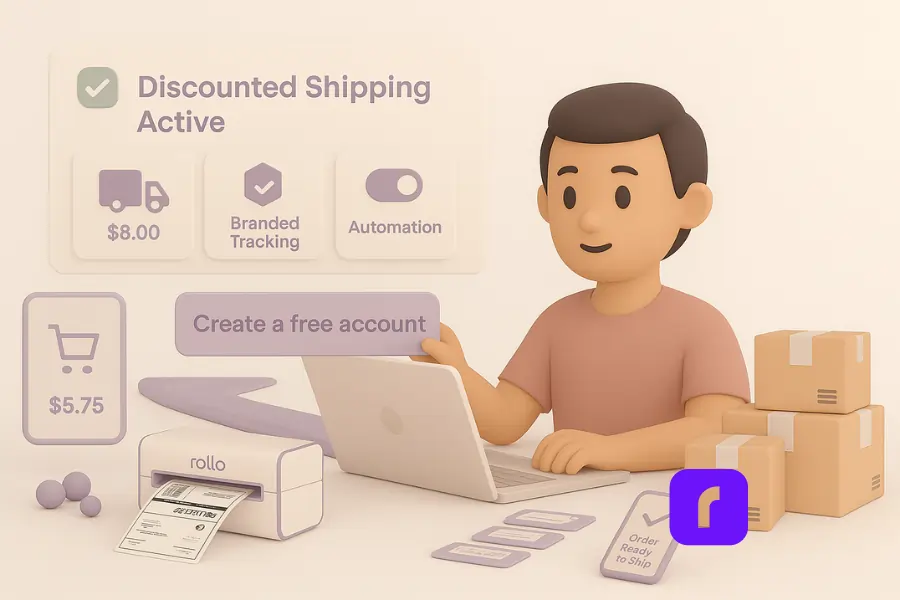
Yes. Many sellers can access shipping discounts without opening separate business accounts with each carrier by using shipping software. This is useful for side hustles, new stores, seasonal sellers, and businesses that do not yet have enough volume to negotiate direct carrier pricing.
This matters because small business shipping volume can be uneven. A handmade goods seller may ship heavily during the holidays, slow down in January, then spike again around Mother’s Day. A beauty brand may send steady parcels all year but see larger bundles during promotions.
With Rollo Ship, sellers can create an account, compare carrier options, buy labels, and print from the same workflow.
Do shipping discounts apply to international shipments?

They do, but the best discounts depend on corridor, weight, paperwork, and your shipping options. USPS offers affordable choices for lighter parcels; Purolator and Canada Post are strong for Canada and U.S.–Canada routes; UPS and FedEx excel at time-definite lanes. The key is clean customs data and the right service.
International must-knows
Cross-border savings are real, but only if your paperwork and service selection are dialed in.
- 🧾 Documents: Harmonized codes, contents, value, and country of origin must be accurate.
- 💰 Duties/Taxes: Landed cost can erase savings if you guess—use calculators or built-in tools.
- 🌍 Carrier choice: Lanes matter. Test USPS Priority Mail International, UPS Worldwide, and FedEx International on your top destinations.
Keep data clean and consistent; sloppy forms trigger delays, returns, and surprise fees.
U.S. and Canada shipping scenarios
Shipping discounts can work for both U.S. and Canadian sellers, but the best option depends on where the order starts, where it is going, which carriers serve that lane, and how much paperwork the shipment requires.
| Seller Scenario | What to Compare | Why It Matters |
|---|---|---|
| U.S. apparel seller shipping 12 oz mailers | USPS vs. UPS vs. FedEx | Lightweight parcels may price differently by zone |
| U.S. electronics seller shipping 8 lb boxes | UPS vs. FedEx vs. USPS | Weight, dimensions, and tracking expectations matter |
| Canadian beauty seller shipping within Canada | Canada Post vs. Purolator vs. UPS/FedEx | Regional lanes can change the better option |
| U.S. seller shipping to Canada | USPS, UPS, FedEx, landed cost, customs data | Cross-border paperwork can affect delays and cost |
| Canadian seller shipping to the U.S. | Canada Post, Purolator, UPS/FedEx | Service, brokerage, and customer expectations matter |

Which shipping discount strategy works best by seller type?
The best shipping discount strategy depends on what you sell. Apparel sellers may save by using lightweight mailers, electronics sellers may need stronger tracking and insurance decisions, and food or chocolate sellers may need to balance delivery speed with packaging protection.
| Seller Type | Common Shipping Problem | Practical Discount Strategy |
|---|---|---|
| Apparel sellers | Lightweight items, many sizes, frequent returns | Use mailers, compare lightweight services, create return label rules |
| Beauty sellers | Small but high-perceived-value bundles | Compare parcel services by weight and zone, protect packaging presentation |
| Homemade goods sellers | Variable package sizes and seasonal demand | Save package presets and compare per order |
| Chocolate sellers | Temperature-sensitive shipments | Compare speed and delivery timing, especially during warm seasons |
| Accessories sellers | Low item cost compared with shipping | Use free shipping thresholds and lightweight packaging |
| Hat sellers | Dimensional weight risk from bulky boxes | Right-size boxes and test package dimensions |
| Sports equipment sellers | Heavy or oversized items | Compare ground services and review surcharges |
| Electronics sellers | Higher-value items and tracking expectations | Compare tracked services and review insurance needs |
The key is not just “get a discount.” The key is to match the discount strategy to the package profile.
What strategies help SMBs save on shipping costs?
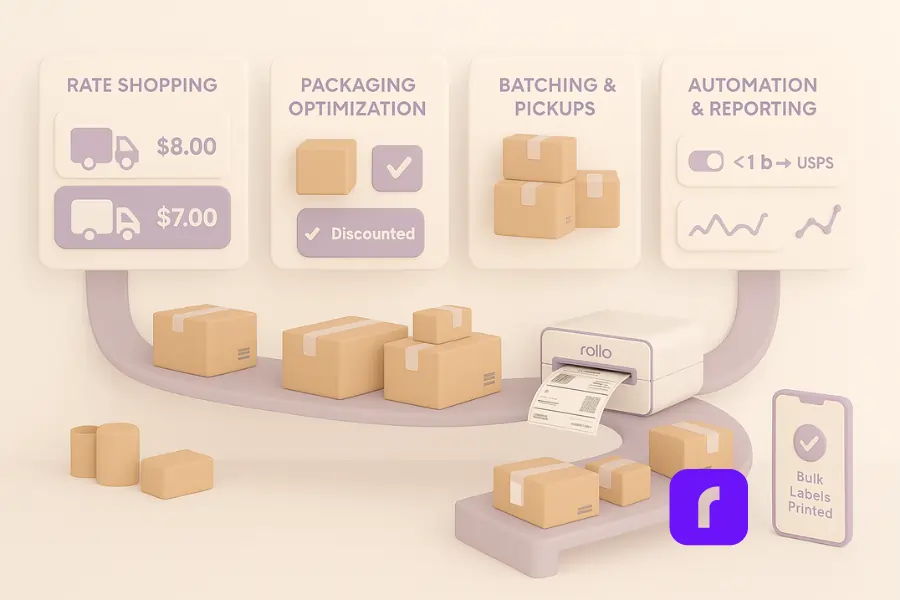
Stack wins. Rate shop by package, right-size boxes to reduce dimensional weight risk, consolidate where it makes sense, and automate the boring stuff. These moves can help sellers control costs and save time each week. For a deeper breakdown, check out our guide on cheap shipping for small business.
Multi-carrier rate shopping
Pick the best price and speed for each order instead of guessing.
- 🔁 Compare USPS, UPS, FedEx, Purolator, Canada Post, and regional options per order.
- 🧩 Use rules like “<1 lb → USPS; 1–5 lb zone 2–4 → UPS; urgent → overnight.”
Let software rate shop automatically so every shipment moves at the lowest viable cost.
Packaging optimization
Your box choice can add dollars to a label—or remove them.
- ✉️ Use lighter mailers for apparel and soft goods.
- 📦 Build a “box matrix” so staff always picks the cheapest fit.
Right-sizing cuts dimensional weight fees and keeps margins healthy.
Batching and pickups
Small process tweaks can save hours each week.
- 🗂️ Group shipments, print in bulk, and schedule pickups. Fewer trips; fewer misses.
Batching smooths your day, reduces errors, and keeps orders moving on time.
Automation & reporting
Let rules handle repetition and use data to spot leaks early.
- 🤖 Auto-apply services, auto-print, auto-notify.
- 📈 Review weekly to spot retail prices creeping in or odd accessorials.
These habits keep labels consistent, costs predictable, and customers informed.
Can shipping discounts make free shipping profitable?
Shipping discounts can make free shipping more realistic, but only when sellers set the right threshold. Instead of offering free shipping on every order, small businesses can use discounted rates to create order minimums that protect margin and encourage larger carts.
For example, a seller with an average order value of $32 may lose margin by offering free shipping on every purchase. But if discounted shipping helps lower the average label cost, that seller may be able to set a free shipping threshold at $50 or $60.
That threshold can do two things at once: encourage customers to add another item and keep the seller from absorbing shipping costs on low-margin orders.
- Average order value
- Average shipping cost
- Most common package size
- Most common destination zones
- Average gross margin
- Return frequency
Review these numbers from your last 30–90 days of orders, then set a free shipping threshold that supports profit instead of copying a competitor’s offer.
How Rollo Ship makes shipping discounts easy for small businesses
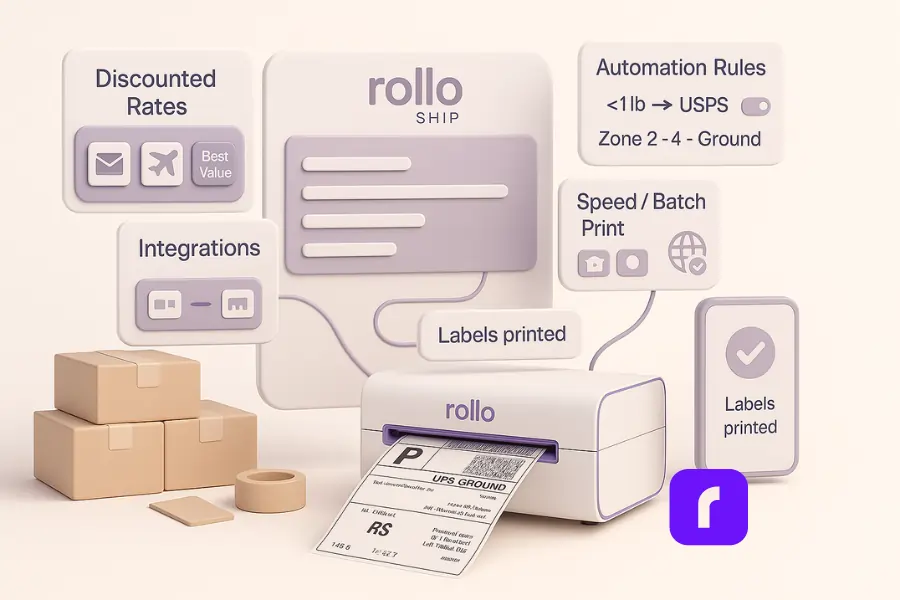
Rollo Ship helps sellers compare available discounted rates from supported carriers, create shipping labels, batch print, and manage fulfillment from one workflow. For small businesses, the main benefit is visibility: you can compare carrier options before buying the label instead of guessing.
In the U.S., Rollo supports USPS, UPS, and FedEx. In Canada, Rollo supports UPS, FedEx, Purolator, and Canada Post, so sellers can compare rates from supported carriers in one dashboard.
Why sellers pick Rollo Ship
If you want lower labels and fewer clicks, this is the toolkit that makes shipping feel simple.
- 💸 Rate comparison: Compare supported carrier options before buying a label.
- 🧠 Automation rules: Map weights, zones, package presets, and SKUs to the right shipping services.
- ⚡ Speed: Print on any printer or pair Rollo Ship with the Rollo Wireless Label Printer.
- 🔗 Integrations: Connect your ecommerce store and marketplaces to keep orders moving.
- 🌐 Cross-border support: Keep customs details organized for international shipments.
- 🎁 Rollo Rewards: Earn points as you ship and unlock additional perks over time.
Add it up and you get faster fulfillment, fewer errors, and consistent savings on every shipment.
Try it: Create your free account and start saving on the next shipment.
How does Rollo Rewards add another savings layer?
Rollo Rewards is a free loyalty program built into Rollo Ship that lets users earn points as they ship, fund their account, and complete eligible activities. As sellers move through reward tiers, they can unlock lower label fees and practical perks such as supplies, hardware, and accessory discounts.
For a small business, that means the shipping workflow can become more valuable over time. You are not just comparing rates on today’s label. You are also building shipping activity that can unlock additional benefits as you grow.
Unlock Shipping Discounts. Ship Smarter with Rollo.
Cut label costs and compare available discounted rates before you ship. Pair Rollo Ship with the wireless, ink-free Rollo printer to move faster, print cleaner labels, and keep fulfillment simple.
- 💸 Compare discounted USPS & UPS rates with Rollo Ship
- 🖨️ Print shipping labels and stickers—no ink, no fuss
- ⚡ Batch print + automation rules for faster fulfillment
- 🎁 Earn points through Rollo Rewards as you ship
- 🌱 FSC-certified, BPA-free materials
Quick setup checklist (copy, paste, ship)
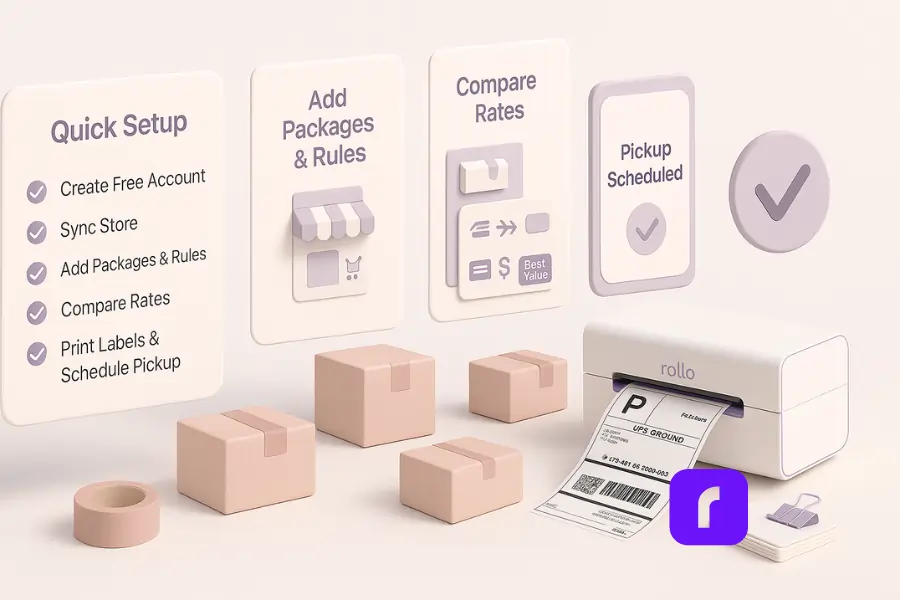
Getting started with Rollo Ship only takes a few minutes—follow this simple checklist to get shipping smarter right away.
- 🆓 Create your free account in Rollo Ship.
- 🔗 Sync your ecommerce store and pull open orders.
- 📦 Add packages, presets, and basic automation rules.
- 📊 Compare rates across carriers; pick the best value, not just the lowest price.
- 🖨️ Print shipping labels in batches; schedule a pickup; done.
- 🎁 Track your Rollo Rewards progress as you ship.
Once you’re set up, every new order flows straight into your dashboard so you can ship faster and save without second-guessing.
Final words
Shipping shouldn’t eat your margin—or your time. Tap discounted rates, compare carriers before buying labels, let rules handle the busywork, and keep your promises to customers without raising prices.
If you’re ready to simplify shipping, Rollo Ship gives you a practical way to compare available rates, print labels, and manage fulfillment from one workflow. Pair it with the Rollo Wireless Label Printer when you’re ready to speed up label printing, and use Rollo Rewards as your shipping activity grows.
Follow Rollo on:
Frequently Asked Questions About Shipping Discounts
📌 Q: What are shipping discounts?
💭 A: Shipping discounts are reduced shipping rates that help businesses pay less than standard retail pricing for eligible shipments. They may come from carrier programs, negotiated accounts, promotional offers, or shipping software that gives sellers access to available discounted rates from supported carriers.
📌 Q: What are shipping discounts for small business?
💭 A: Shipping discounts for small business are reduced carrier rates designed to help smaller sellers lower delivery costs without needing enterprise-level volume. They can help online stores protect margins, offer more competitive shipping options, and compare carrier rates before buying labels.
📌 Q: How can small businesses get shipping discounts?
💭 A: Small businesses can get shipping discounts through direct carrier accounts, volume-based programs, or shipping software. For many SMBs, shipping software is the easiest starting point because it can provide access to available discounted rates and rate comparison tools without separate carrier negotiations.
📌 Q: Do I need high shipping volume to get discounted rates?
💭 A: Not always. High volume may help with direct carrier negotiations, but many sellers use shipping software to access available discounted rates without meeting strict carrier volume thresholds. This is useful for new stores, side hustles, seasonal sellers, and growing e-commerce brands.
📌 Q: Which carrier has the best shipping discounts for small business?
💭 A: No single carrier has the best shipping discounts for every small business. USPS, UPS, FedEx, Canada Post, and Purolator can each make sense depending on package weight, size, destination, speed, and service needs. The better approach is to compare rates per shipment.
📌 Q: Is shipping software better than a direct carrier account?
💭 A: Shipping software is often better for small and midsize sellers because it allows rate comparison, label printing, automation, tracking, and store connections in one workflow. Direct carrier accounts may still make sense for larger shippers with stable volume and predictable package profiles.
📌 Q: Can I get shipping discounts without a business account?
💭 A: Yes. Many sellers can access available discounted rates through shipping software without opening separate business accounts with each carrier. This helps smaller sellers compare rates, buy labels, and manage fulfillment before they are large enough to negotiate direct pricing.
📌 Q: Do shipping discounts apply to international shipments?
💭 A: Yes, shipping discounts can apply to international shipments, but the right option depends on destination, package weight, customs requirements, delivery speed, and carrier service. Cross-border sellers should compare rates and keep customs information accurate to avoid delays and unexpected costs.
📌 Q: Can Canadian sellers use Rollo Ship?
💭 A: Yes. Rollo Ship supports Canadian sellers with carrier options that include UPS, FedEx, Purolator, and Canada Post. Rollo also supports U.S. sellers with USPS, UPS, and FedEx, allowing sellers in both countries to compare supported carrier rates in one dashboard.
📌 Q: How does Rollo Rewards work?
💭 A: Rollo Rewards is built into Rollo Ship and lets users earn points as they ship, fund their account, and complete eligible activities. Reward tiers can unlock lower label fees and perks such as label packs, hardware, and accessory discounts as shipping activity grows.


