
TL;DR: A shipping original art carrier comparison comes down to three variables: declared value, package fragility, and total landed cost. In the US, artists weigh USPS, UPS®, and FedEx. In Canada, Canada Post and Purolator join the mix. Declared value protects the sale price. A claim pays out only with proof of value and proof of proper packaging. Framed and canvas pieces also trigger dimensional weight, so the box size—not just the weight—drives the price.
Key Facts About Shipping Original Art
- Declared value is not insurance. It sets the maximum a carrier will reimburse if a claim is approved.
- Most carriers require proof of value (receipt, invoice, or appraisal) and proof of proper packaging to pay a damage claim.
- Framed art is priced on dimensional (DIM) weight, so a large, light frame can cost more than its actual weight suggests.
- In the US, the main carriers for art are USPS, UPS®, and FedEx. In Canada, Canada Post and Purolator are common.
- A Canada-to-US art shipment adds customs forms and declared-value rules that differ from a domestic move.
- Comparing carrier rates per piece, before printing the label, is the most reliable way to control art shipping costs.

For an independent artist, every shipment is a small gamble. A shipping original art carrier comparison should answer three questions at once: which carrier to trust, how much declared value to add, and whether the price is fair. Original work is fragile, oddly shaped, and often worth more than its sale price suggests. One cracked frame can erase a sale and a reputation.
This guide is for artists, illustrators, and Etsy art sellers in the US and Canada. It covers paintings, prints, and framed pieces. It explains the cost logic before naming any platform—so the decision stays yours.
What a shipping original art carrier comparison actually compares

A shipping original art carrier comparison weighs four things for each piece: declared value, fragility, box dimensions, and total landed cost. It is not about finding one carrier for everything. A small unframed print and a large framed canvas rarely belong on the same service. The goal is matching each shipment to the carrier that protects it for a sensible cost.
A few definitions make the rest of this guide easier.
- Declared value is the amount you tell the carrier a piece is worth. It caps a payout; it does not guarantee one.
- Dimensional (DIM) weight is a price based on box size, not actual weight. Large, light frames are priced this way.
- Landed cost is the full cost of a shipment: postage plus declared-value fees plus packaging.
Once those three are clear, the carrier question gets much simpler.
Which carrier balances cost and protection for shipping art?

No single carrier wins for every art shipment. The right fit depends on the piece’s value, size, and fragility. In the US, artists compare USPS, UPS®, and FedEx. In Canada, Canada Post and Purolator cover most domestic lanes, with UPS® and FedEx available for heavier or expedited pieces. Match the carrier to the shipment, not the shipment to the carrier.
Here is a service-based view, with no claim that any one carrier is “best.”
| Carrier | Market | Common art fit | Declared-value / coverage notes |
|---|---|---|---|
| USPS | US | Small prints, flats, lower-value pieces | Some services include limited default coverage; additional value can be purchased separately |
| UPS® | US & Canada | Framed pieces, higher-value or bulkier art | Declared value can be added per package |
| FedEx | US & Canada | Heavier, oversized, or higher-value art | Access via a connected FedEx account |
| Canada Post | Canada | Domestic prints, parcels, lighter framed pieces | Service-based domestic coverage; added value available on select services |
| Purolator | Canada | Domestic parcels and expedited lanes | Integrated Canadian domestic carrier |
Coverage also varies by service, not just by carrier. USPS includes up to $100 of coverage on Priority Mail and Ground Advantage, with more available for a fee.
The practical takeaway: a $40 unframed print and a $900 framed original ask different questions of a carrier. Comparing them on the same screen is what turns guesswork into a decision.
Art shipping declared value: how much to declare and what a claim needs

Art shipping declared value is the amount you tell the carrier the piece is worth. It caps the payout if a claim is approved — it does not promise payment. Carriers generally reimburse the lower of the declared value or the proven value. To support a claim, keep documentation and photograph the packed piece before it ships.
A claim usually needs three things:
- Proof of value — a receipt, invoice, sales record, or appraisal.
- Proof of proper packaging — photos of the wrapped and boxed piece before sealing.
- A timely filing — claims have deadlines that vary by carrier and country.
Under-declaring saves pennies but risks the full piece. Over-declaring wastes money on coverage you cannot prove. The honest answer to “How much declared value?” is to declare what you can document and no more.
US and Canadian rules differ in detail. A US domestic claim runs on the US carrier’s terms. A Canadian domestic claim runs on Canada Post or Purolator terms. Cross-border adds a third set of rules, covered further below.
How to package art safely for transit

Most damage claims fail not because the carrier was careless but because the packaging could not prove the piece was protected. Safe art packaging controls three forces: surface contact, shock, and pressure. The fix is layered: protect the surface, cushion the piece, then give it a rigid shell.
A reliable layering order for framed and canvas work:
- Surface layer: glassine or acid-free paper against the artwork, never plastic directly on paint.
- Edge and corner protection: cardboard or foam corner guards on frames and stretched canvas.
- Cushioning: bubble or foam wrap around the whole piece, taped so it cannot shift.
- Rigid shell: foam board or a picture/mirror box sized close to the piece.
- Double-boxing: for glass or high-value frames, box-in-box with cushioning between layers.
- Glass risk: consider removing glass and shipping it separately or replacing it with acrylic.
Right-sizing the outer box matters twice. Too loose, and the piece moves and cracks. Too large, and dimensional weight inflates the price.
Artist shipping cost strategy: where the money actually leaks

An artist’s shipping cost strategy is about controlling the costs you can see and the ones you cannot. The visible cost is postage. The hidden costs are DIM weight on large frames, declared-value fees, and time lost comparing carrier portals. For framed art, a piece can be light but big, so the box size sets the price.
Three moves recover most of the leakage:
- Right-size the box. A frame in a snug picture box often beats the same frame in a generic large carton on price and on safety.
- Declare what you can prove. Pay for coverage you could actually claim, not a round number that feels safe.
- Compare before you commit. The same piece can price differently across carriers and services on the same day.
If you ship framed work often, modeling dimensional weight before you buy a box is worth the few minutes.
US vs Canada and cross-border art shipping

Shipping art within Canada differs from shipping within the US, and cross-border adds another layer. Domestic Canadian moves usually run on Canada Post or Purolator. US domestic moves run on USPS, UPS®, or FedEx. A Canada-to-US gallery sale adds customs paperwork and declared-value rules that can differ from domestic coverage.
For a cross-border art shipment, plan for:
- A commercial invoice describing the piece, its value, and country of origin.
- A customs form and, where required, an HS code (Harmonized System code) classifying the item.
- Declared value at the border, which may follow different limits than a domestic shipment.
For U.S.-bound pieces, U.S. Customs and Border Protection expects the customs value to reflect the price the buyer paid. That is the sale price, not the planned resale price.
Cross-border gallery deadlines leave little room for a held parcel. Building the customs paperwork into the workflow — rather than at the counter — is what keeps a fragile piece moving.
The end-to-end art shipping workflow

Shipping a piece of art follows the same path every time, whether you send one print a week or fifty. Mapping each step removes guesswork and reduces the errors that turn into claims. The workflow below applies to a single artist and to a growing print-on-demand shop alike.
| Step | What happens | Why it matters for art |
|---|---|---|
| 1. Import or enter the order | Pull the order from your store, or key it in | Captures the buyer’s address and the sale value |
| 2. Package the piece | Layer, cushion, and box the artwork | Bad packaging is the top reason claims are denied |
| 3. Compare carrier rates | View live rates across carriers | A $900 frame and a $40 print want different services |
| 4. Set declared value | Match coverage to provable value | Caps the payout if the piece is damaged |
| 5. Create the label | Generate the shipping label | Locks in carrier, service, and declared value |
| 6. Print the label | Print on a thermal or standard printer | Clean, scannable labels reduce mis-sorts |
| 7. Hand off the shipment | Drop off or schedule pickup | Starts the carrier’s clock and tracking |
| 8. Track delivery | Monitor until delivered | Early visibility on delays protects gallery deadlines |
Once the cost logic is clear, the next question is which platform structure gives an artist the most control across all of these carriers at once.
How a multi-carrier shipping platform solves art shipping

A multi-carrier shipping platform brings every carrier into one screen, so the comparison happens before the label prints. Instead of logging into separate portals, you see live rates side by side, set the declared value once, and print from one workflow. Rollo Ship is a multi-carrier shipping platform built for exactly this, available across the US and Canada.
Rollo Ship connects USPS, UPS®, FedEx, Canada Post, and Purolator in one account. Rollo is not a carrier. Postage is always paid directly to the carrier you select, and the platform’s per-label service fee is separate from that postage.
For an artist, three capabilities matter most:
- One comparison screen. Rollo Ship’s AI-powered rate selection groups similar orders, applies your shipping rules, and recommends the cheapest qualifying service before the label prints.
- FedEx on a free plan. FedEx access is included by connecting your FedEx account—useful for heavier or higher-value framed pieces.
- Ship from your phone. Rollo Ship runs on web, iOS, and Android, so you can package a piece and create its label from the same spot.
On carrier economics, Rollo Ship provides access to discounted USPS rates — up to 90% off retail USPS rates on select services — and discounted UPS® rates.
Discounts off UPS daily rates. Rates are limited to shipping from the U.S. only. Rates and any applicable discounts are subject to change at any time without notice.

Canada Post and Purolator are offered on a service basis for domestic Canadian coverage. FedEx access is account-based, with no platform-level discount claim.
The platform is also a system for keeping costs honest as you grow. Rollo Ship holds a 4.8-star rating on Capterra. Separately, more than 500,000 sellers across the US and Canada use Rollo Ship to compare carriers and print labels.
Pricing is simple and tied to volume. Rollo Ship is free to start, with no monthly subscription. The first 200 labels are fee-free for new users. After that, a per-label service fee starts at 5¢ and decreases to as low as 1¢ at the VIP tier of Rollo Rewards as your volume grows. Postage is still paid directly to the carrier; the per-label fee is separate.
A short scenario. An Etsy art seller in Canada sells a framed print to a buyer in the US. Etsy sellers can use Rollo Ship to generate labels manually, without linking an Etsy store. They package the frame, compare Canada Post, UPS®, and FedEx on one screen, set declared value to the documented sale price, attach the customs paperwork, and print. Landed cost is visible on screen before they commit to a label.
Print the Label Without
Slowing Down the Workflow
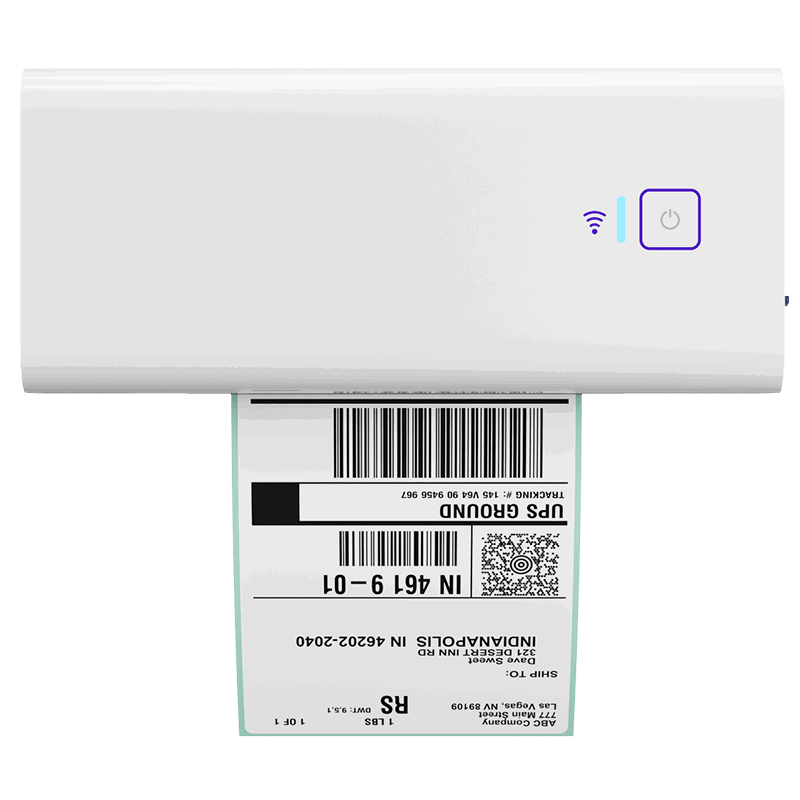
Once you know which shipping path makes the most sense, the next step should feel simple. Rollo’s Wireless Printer helps you print crisp 4×6 labels quickly, so your packing station keeps moving without adding extra friction to the order.
What happens without a system like this

Without a single platform, art shipping fragments. Each carrier lives in its own portal, with its own login, label flow, and declared-value screen. Comparing three carriers means opening three tabs and re-entering the same dimensions for one piece.
There is a quieter cost too. Some subscription-based shipping tools charge the same monthly fee whether you ship one piece or fifty. Other carrier-specific portals only show their own rates, so there is no cross-carrier view at the moment of decision. Cost never improves as the shop grows, and the comparison never gets easier.
None of that is dramatic. It is just a steady drag—minutes per shipment and dollars per frame that add up across a season.
Who this is NOT for
This approach is not for everyone, and that is fine.
- Very low or one-off volume. If you ship a single piece a year, a carrier’s native tool may be all you need.
- Sellers locked into a 3PL. If a fulfillment partner controls label creation, you may not set the carrier or declared value yourself.
Naming these cases honestly is the point. Rollo Ship is a structural fit for artists who control their own shipping—not a universal answer for every situation.
When to try Rollo Ship
Rollo Ship fits artists who ship fragile, higher-value pieces and want to see landed cost before committing to a label. If you sell on Shopify, eBay, Amazon, WooCommerce, or TikTok Shop — or ship manually as an Etsy art seller — you can compare carriers, set declared value, and print professional labels from one place.
For the artist who hates surprise charges, the draw is landed-cost clarity across carriers on one screen. For the artist who feels behind on shipping, the draw is one dashboard and fewer steps that can go wrong.
Once the cost logic above is clear, a multi-carrier platform is simply the structure that holds it together: every carrier, every declared-value choice, and every label in one workflow. Rollo Ship is that workflow for the US and Canada—free to start, with no monthly subscription, the first 200 labels fee-free, and a per-label fee that can fall from 5¢ to 1¢ through Rollo Rewards.
Start with Rollo Ship and compare carriers on your next piece before you print the label.
Make Cross–
Border
Shipping
Easier
to Repeat
If you are tired of bouncing between tabs, second-guessing label choices, and dealing with surprise-fee fallout later, Rollo Ship gives you one place to compare rates, manage label flow, and make clearer shipping decisions before you buy.

Follow Rollo on:
Frequently Asked Questions About Shipping Original Art (Carrier Comparison, Declared Value, Packaging)
📌 Q: How do I insure artwork during shipping, and what documentation do I need for a claim?
💭 A: You add declared value to the shipment, which sets the maximum a carrier will reimburse if a claim is approved. To support a claim, keep proof of value—a receipt, invoice, or appraisal—and photograph the piece packed before sealing. File within the carrier’s deadline. A multi-carrier platform lets you set declared value alongside the rate, so coverage and cost are decided together.
📌 Q: Which carrier is most reliable for sending paintings in the US and Canada?
💭 A: Reliability depends on the piece’s value, size, and fragility, not on one carrier being universally better. US artists usually compare USPS, UPS®, and FedEx; Canadian artists use Canada Post and Purolator, plus UPS® or FedEx for heavier pieces. Matching the carrier to the shipment matters more than picking a single favorite. Comparing live rates per piece is the most dependable approach.
📌 Q: How much declared value should I add when shipping original art?
💭 A: Declare the amount you can actually document, and no more. Carriers generally pay the lower of the declared value or the proven value, so an inflated figure you cannot support will not pay out. Keep a sales record or appraisal on hand. For a piece sold at a known price, the documented sale price is usually the cleanest declared value.
📌 Q: What is the safest way to package a framed painting or canvas for transit?
💭 A: Layer the protection: glassine or acid-free paper on the surface, corner guards on the frame, cushioning around the piece, and a rigid box sized close to the artwork. For glass or high-value frames, double-box with cushioning between layers, or ship the glass separately. Photograph each stage before sealing, in case you need to prove proper packaging later.
📌 Q: How can I safely ship a fragile painting internationally for a gallery sale?
💭 A: Build in extra protection and customs paperwork early. Use museum-grade packing — surface protection, rigid reinforcement, and double-boxing — and prepare a commercial invoice plus any required customs form and HS code. Declared-value limits at the border can differ from domestic coverage. Doing the paperwork before drop-off keeps a time-sensitive gallery shipment moving.
📌 Q: Does shipping framed art cost more because of the frame size?
💭 A: Often, yes. Carriers price large parcels on dimensional (DIM) weight, which is based on box size rather than actual weight. A light but large frame can be billed by its dimensions. Right-sizing the outer box—snug enough to protect the piece, no larger—controls both damage risk and DIM cost.


