
TL;DR: Returns are one of the largest hidden costs in Direct-to-Consumer (DTC) operations. This guide explains how to reduce return direct-to-consumer shipping costs across the three places they hide: the return label, restocking, and lost resale value. The biggest single lever is pricing every return label across multiple carriers instead of defaulting to one. It also covers who should pay for return shipping and how U.S. and Canadian return legs differ. Written for apparel, jewelry, and beauty brands shipping in the United States and Canada.
Key Facts About Reducing Return Shipping Costs
- Return cost has three components: the return-shipping label, restocking labor, and lost resale value.
- An estimated 19.3% of online sales will be returned in 2025 (NRF, 2025 Retail Returns Landscape)
- 72% of retailers now charge for at least one return option, up from 66% in 2024 (NRF, 2025)
- Restocking fees, when charged, are deducted as a share of the refund—and the handling labor exists even when no fee is charged.
- Return-label prices vary by carrier, service, and zone, so single-carrier return labels leave savings uncaptured.
- U.S. and Canadian return legs use different carriers and rate structures; cross-border returns add duties and brokerage considerations.
Table of Contents

If you run a direct-to-consumer (DTC) brand in streetwear, jewelry, or beauty, returns are not an edge case. They are a recurring cost center. Knowing how to reduce return costs is now a margin skill, not an operations afterthought. Every returned hoodie, ring, or serum carries a return label, handling time, and often a markdown on resale.
This playbook is for the DTC operator shipping from the United States or Canada. It breaks down what returns actually cost, who should pay for them, and how to shrink the return-shipping line specifically. The examples span apparel, jewelry, and beauty, but the mechanics apply to any high-return category.
What Does Return Shipping Actually Cost to DTC Brands

A return costs a DTC brand three ways: the return-shipping label, the labor to inspect and restock the item, and the value lost when the item cannot be resold at full price. The label is the most controllable of the three because its price varies by carrier and service. Most brands only ever see one carrier’s price.
Start with the label. Return legs are often residential-to-warehouse, which prices differently than your outbound lanes. A return label bought on autopilot is rarely the least expensive qualifying option.
Then add restocking. Restocking fees charged to customers are typically set as a percentage of the refund value, but the internal labor cost exists whether or not you charge a fee. Someone opens the box, inspects the item, and re-shelves it. That is real payroll.
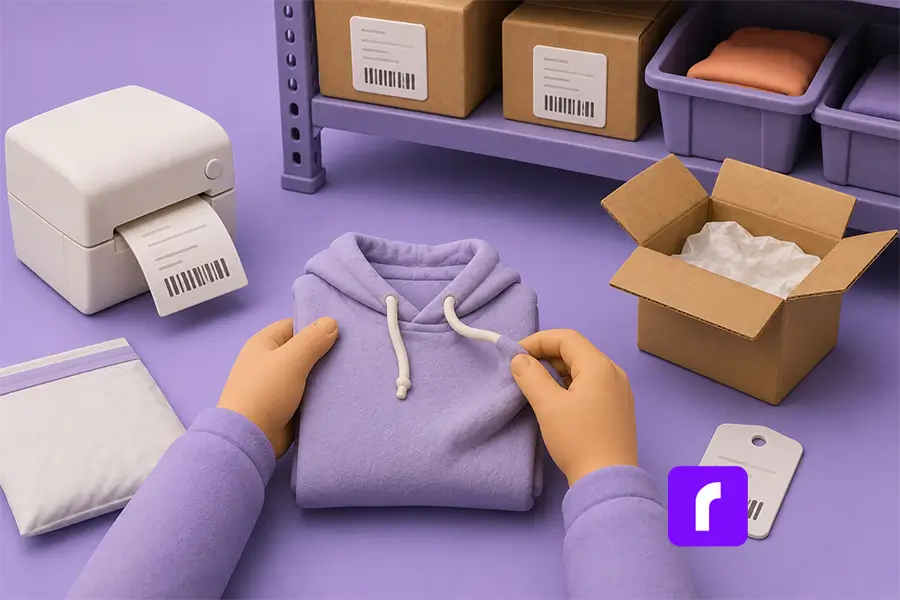
Finally, the category tax. In 2025, 26% of U.S. consumers returned clothing bought online—the highest rate of any retail category (Capital One Shopping Research, updated January 2026)—with sizing as the leading driver.
Jewelry and beauty return less often, but beauty returns are frequently unsellable once opened. The math differs by vertical.
If your outbound apparel costs also feel opaque, that is a separate problem with its own fixes. See how apparel brands control shipping costs for the outbound side.
Who Pays for Return Shipping — and How That Choice Affects Margin

There is no free return. Either the customer pays for return shipping, the brand absorbs it, or the cost is spread into product pricing. 72% of retailers now charge for at least one return option, up from 66% in 2024 (NRF, 2025 Retail Returns Landscape, October 2025). The right policy depends on your margin per order, your return rate, and your category.
Free returns raise conversion and raise return rates at the same time. Paid returns filter out casual returners but can suppress first purchases from cautious buyers. Neither is universally correct.
And the fee carries real risk: 57% of shoppers say they won’t return to a retailer after being charged for a return, up sharply from 40% in 2024 (NRF, 2025).
A practical middle path is a tiered policy. Free returns for exchanges or store credit and paid returns for refunds. Some brands waive the fee above an order-value threshold. Others charge it only on final-sale-adjacent categories like opened beauty products.
Whatever you choose, price the policy on real label costs. A $9 flat return fee means something different depending on what your actual return label costs — a number that shifts materially by carrier, service, and zone. Many brands set the fee before checking what the return leg actually costs. Check first.
How to Reduce Return Shipping Costs

The fastest way to reduce return costs is to attack the label itself: compare return-label rates across multiple carriers for every return, control dimensional (DIM) weight on bulky returns, and right-size return packaging. Policy changes help at the margins. The label is where the recurring, per-return savings live.
Here is the working checklist.
1. Compare carriers on the return shipping leg every time. The cheapest qualifying service for a return from a buyer in rural Alberta is not the same as one from downtown Chicago. Single-carrier return labels lock in whatever that carrier charges for that lane. Multi-carrier comparison turns each return into a small pricing decision.
2. Control DIM weight on bulky returns. DIM (dimensional) weight bills a parcel on its box volume when that exceeds its actual weight. Puffer jackets, sneaker boxes, and gift sets are classic DIM traps on the return leg. The mechanics are covered in dimensional weight vs actual weight—the short version is a smaller box, a smaller bill.
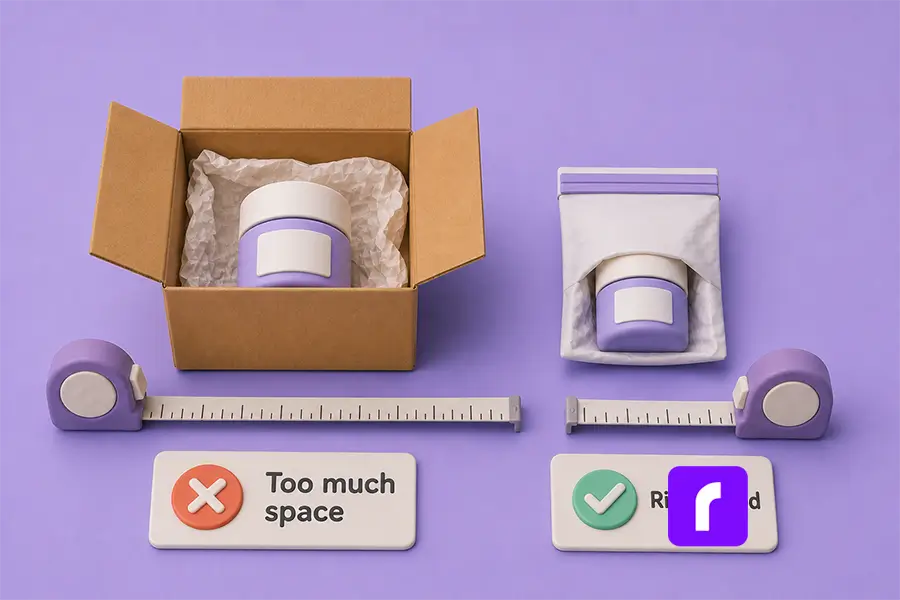
3. Right-size the return shipping packaging. Include a foldable poly mailer for apparel returns instead of letting the buyer reuse the oversized outbound box. A jewelry return should travel in a padded envelope, not a shoe box. Small instruction, large effect.
4. Route exchanges before refunds. An exchange keeps the revenue and still costs one return label. A refund costs the label plus the sale. Nudging buyers toward exchanges shrinks the total cost of each return event.
5. Match service speed to urgency. Returns rarely need expedited service. A ground or economy service on the return leg is usually acceptable to everyone. Speed costs money that returns don’t need to spend.
Beauty brands have one extra wrinkle: opened cosmetics often cannot restock at all. For that category, the return label is sometimes the only recoverable cost — the outbound side matters even more, and how sellers ship perfumes and cosmetics covers it.
U.S. vs Canada: Direct-to-Consumer Return Shipping and Cross-Border Nuances

Domestic U.S. returns typically travel on USPS, UPS®, or FedEx; domestic Canadian returns on Canada Post or Purolator. Cross-border returns are a different animal: a U.S. brand accepting a return from a Canadian buyer is importing goods, which can involve duties, taxes, and brokerage on re-entry. Plan the two lanes separately.
| Return lane | Typical carriers | Cost consideration |
|---|---|---|
| U.S. domestic | USPS, UPS®, FedEx | USPS is often competitive on lightweight apparel and jewelry; UPS® and FedEx can win on heavier or bulkier parcels |
| Canadian domestic | Canada Post, Purolator | Canada Post covers the residential pickup network broadly; Purolator is strong on heavier parcels |
| Cross-border (Canadian buyer → U.S. brand) | Varies by routing | Treated as an import: duties, taxes, and brokerage can apply on re-entry; consider a consolidation address or a refund-without-return threshold |
For U.S. domestic returns, USPS is often competitive on lightweight apparel and jewelry returns, while UPS® and FedEx can win on heavier or bulkier parcels. The winner shifts by weight, zone, and box size. That is the argument for comparing rather than assuming.
For Canadian domestic returns, Canada Post covers the residential pickup network broadly, and Purolator is a strong domestic option for heavier parcels. Canadian sellers can run both carriers from a single workflow rather than two separate portals.
Cross-border returns deserve their own policy line. Many brands route Canadian returns to a Canadian consolidation address or offer a refund without return below a value threshold when re-import costs exceed the item’s resale value.
U.S.-origin goods can re-enter duty-free under HTSUS subheading 9801.00.10 if they were not advanced in value abroad, but the importer carries the burden of proof, and CBP can request supporting declarations on shipments over $2,500 (U.S. Customs and Border Protection). Decide this before the first cross-border return arrives, not after.
The Direct-to-Consumer Return Shipping Workflow, Step by Step

A returns workflow has five stages, and cost hides in each one. Mapping the workflow makes the leakage visible. Most brands discover their biggest losses sit at the label-creation step, where the first quoted rate is accepted without comparison.
| Step | What happens | Where cost hides |
|---|---|---|
| 1. Return intake | Buyer requests a return through your store on Shopify, WooCommerce, eBay, Amazon, or TikTok Shop | The refund-vs.-exchange path not set; every request defaults to a refund |
| 2. Label creation | A return label is generated and sent to the buyer | Single-carrier pricing; oversized box triggers DIM charges |
| 3. Transit and receipt | The item travels back to your warehouse or 3PL | Expedited service chosen by default when economy would do |
| 4. Inspect and restock | Item is checked, restocked, or written off | Restocking labor; lost resale value on opened or worn items |
| 5. Refund or exchange | Buyer is refunded, credited, or exchanged | Return fee not matched to the real label cost |
Two of these five stages are pure label economics. Those two are also the easiest to fix.
Once the cost structure of returns is clear, the next question is which platform structure gives a brand the most control over the return leg.
How a Multi-Carrier Shipping Software Reduces Return Shipping Costs

A multi-carrier shipping platform reduces return costs by putting every carrier’s return-label price side by side before the label is purchased. Instead of accepting one carrier’s rate for every return, the operator sees the qualifying options for that specific lane, weight, and box, then picks the least expensive one.
The pattern matters more than any single brand. Look for three structural traits: multiple carriers in one account, no monthly subscription, so low-return months cost nothing, and per-label economics that improve with volume. A returns cost problem is a per-label problem, so per-label pricing fits it.
This is where Rollo Ship fits. Rollo is a multi-carrier shipping platform available in the United States and Canada that lets users compare carrier rates, generate shipping labels — including return labels — and manage shipments from a single dashboard.
It connects shippers to five carriers: USPS, UPS®, FedEx, Canada Post, and Purolator. UPS® and FedEx connect through the shipper’s own account. Rollo is not a carrier; postage is always paid directly to the carrier, and Rollo’s per-label fee is separate from postage.

A seller with both U.S. and Canadian return flows runs both sides from one account. U.S. return labels are priced across USPS, UPS®, and FedEx. Canadian domestic return labels run on Canada Post or Purolator — no second platform, no second login.
Canadian sellers can see how Canada Post and Purolator fit into one workflow on the Rollo Canada page and the Canada Post carrier page.
Rollo Ship’s AI-powered rate selection groups similar orders, applies the seller’s shipping rules, and recommends the cheapest qualifying service before the label is printed. On the return leg, that means each return label is priced against every available carrier automatically. No portal-hopping, no guessing.
The scope is worth stating plainly. Rollo generates return labels—with access to discounted USPS rates up to 90% off retail USPS rates on select services—helps control DIM on bulky returns and compares carriers on every return leg. It is not a returns-management system — there are no RMA portals, return-reason analytics, or exchange flows inside it. The value is the cost of the return shipping itself.
Consider a Shopify streetwear seller in the U.S. handling a steady monthly flow of returns from both U.S. and Canadian buyers. Today, every return label comes from one carrier at whatever that carrier charges. On a multi-carrier platform, each U.S. return is priced across USPS, UPS®, and FedEx, and each Canadian-side return across Canada Post and Purolator. The per-label saving varies by lane, but it repeats on every single return.
Rollo Ship holds a 4.8★ rating on Capterra. Separately, more than 500,000 sellers across the US and Canada ship on Rollo.
What Happens Without a System Like This

Without a multi-carrier structure on the return leg, three leaks run quietly and permanently. None of them show up as a line item. That is what makes them expensive.
First, every return label is priced by one carrier. There is no visibility into whether another carrier would have moved the same box back for less. The overpayment is invisible because the cheaper number was never on screen.
Second, the return cost is invisible per order. Restocking labor, the return label, and the refund sit in three different reports. No one can say what returning a size-L hoodie from Ontario actually costs the business.
Third, DIM charges on returns go unchallenged. The buyer packs the item in whatever box is handy, and the oversized box bills by volume, not weight. Nobody audits the return leg the way outbound gets audited.
Individually, each leak is small. Multiplied across the roughly one in five online orders that come back, they compound into a real margin drag.
Print the Label Without
Slowing Down the Workflow
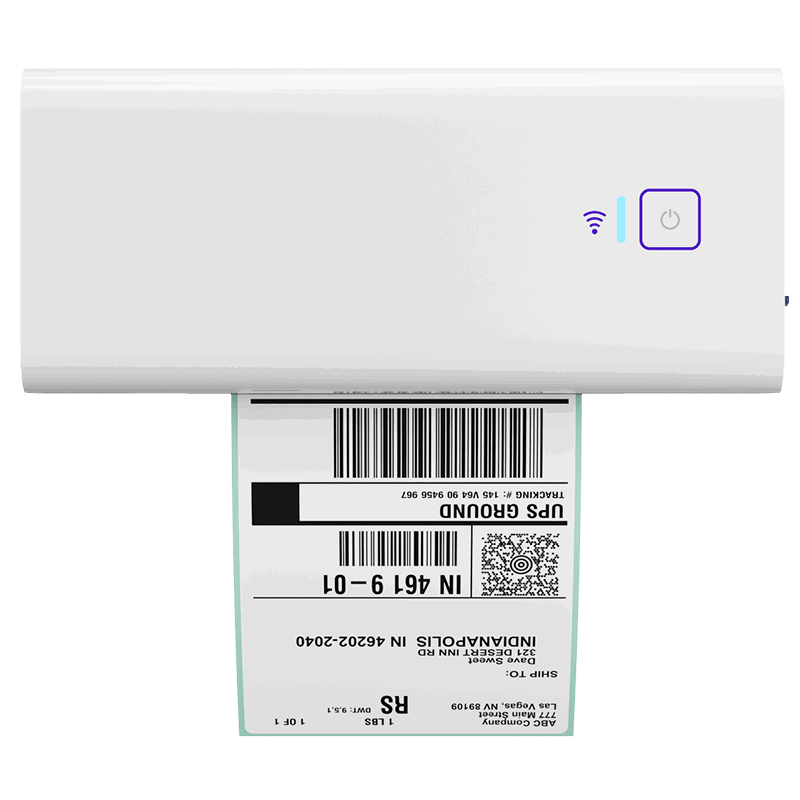
Once you know which shipping path makes the most sense, the next step should feel simple. Rollo’s Wireless Printer helps you print crisp 4×6 labels quickly, so your packing station keeps moving without adding extra friction to the order.
Who This Is NOT For

This playbook targets a specific problem: recurring return-shipping cost in high-return DTC categories. It is not for everyone.
- Brands with negligible returns. If returns are under a handful per month, policy simplicity beats optimization. Fix outbound costs first.
- Brands whose marketplace fully manages returns. If a marketplace issues the return labels and controls the workflow, the label cost is not yours to optimize.
- One-off or very-low-volume shippers. Comparing carriers per return pays off through repetition. Without volume, the effort exceeds the savings.
- Brands looking for RMA portals or return-reason analytics. That is returns-management software, a different category. This playbook—and Rollo Ship—covers the cost of the return shipping itself.
When to Try Rollo Ship

Rollo Ship fits when return labels are a recurring cost line and no returns management suite is needed. It is free to start, has no monthly subscription, and prices every return label across five carriers. A per-label fee starts at 5 cents and falls to 1 cent through Rollo Rewards.
The first 200 labels are fee-free for new users, and postage is always paid directly to the carrier. Try Rollo Ship for free—no subscription required.
For the cost-focused operator, the appeal is arithmetic. Every return label gets compared across five carriers, and the per-label fee falls as volume grows. Return costs stop being a fixed tax and start behaving like something you manage.
For the overwhelmed operator juggling Shopify, eBay, Amazon, and TikTok Shop orders, the appeal is consolidation. Outbound labels and return labels live in one dashboard. Fewer portals, fewer errors, one view of shipping spend.
Printing return labels in-house is simpler on direct thermal. The Rollo Wireless printer uses no ink, no toner, and no cartridges—get the Rollo Wireless printer here.
Returns will keep coming; the only question is what each one costs you. Rollo is a multi-carrier shipping platform built so shipping economics improve as a brand grows, on the outbound leg and the return leg alike. Start shipping with Rollo Ship—it’s free to start, and the first 200 labels are fee-free.
Make Cross–
Border
Shipping
Easier
to Repeat
If you are tired of bouncing between tabs, second-guessing label choices, and dealing with surprise-fee fallout later, Rollo Ship gives you one place to compare rates, manage label flow, and make clearer shipping decisions before you buy.

Follow Rollo on:
Frequently Asked Questions About How to Reduce Return Shipping Costs
📌 Q: Do customers pay for return shipping?
💭 A: It depends on the brand’s policy. Many DTC brands now charge a return fee for refunds while keeping exchanges free. A growing majority of retailers now charge for at least one return option (NRF, 2025 Retail Returns Landscape). The fee should be set against real return-label costs. A multi-carrier platform like Rollo Ship makes those real costs visible before the policy is priced.
📌 Q: What is a restocking fee, and how much is typical?
💭 A: A restocking fee is a deduction from the refund that covers inspecting, repackaging, and re-shelving a returned item. The fee is set as a percentage of the refund value and varies by category and item condition. Even when no fee is charged to the customer, the internal handling cost still exists. It belongs in any honest return-cost calculation.
📌 Q: Are free returns or paid returns better for DTC brands?
💭 A: Neither is universally better. Free returns lift conversion but also lift return rates; paid returns filter casual returners but can deter first-time buyers. Many brands land on a tiered policy: free exchanges and paid refunds. The decision should rest on margin per order, category return rate, and the actual price of the return label.
📌 Q: How can a small brand reduce return shipping costs without new software subscriptions?
💭 A: Start with three no-subscription moves: compare return-label prices across carriers instead of defaulting to one, right-size return packaging to avoid dimensional-weight charges, and route buyers toward exchanges before refunds. A no-subscription multi-carrier platform like Rollo Ship supports all three, with a small per-label fee instead of a monthly cost.
📌 Q: How do returns work for orders shipped to Canada?
💭 A: A cross-border return is an import for the receiving brand, so duties, taxes, and brokerage can apply on re-entry. Common approaches include a Canadian consolidation address, refund-without-return below a value threshold, or domestic Canadian return labels on Canada Post or Purolator. Deciding the cross-border policy in advance prevents case-by-case losses.
📌 Q: Does the carrier matter for return labels?
💭 A: Yes, materially. Return-label prices differ by carrier, service, weight, zone, and box size, and the cheapest option shifts lane by lane. Lightweight apparel returns often favor one carrier, while bulky parcels favor another. Comparing all qualifying services per return is the highest-leverage repeatable move to reduce return shipping costs.


