
TL;DR: Shipping costs in 2026 are rising for most US and Canadian sellers even when base carrier rates appear unchanged. The real drivers are surcharges—residential delivery fees, dimensional weight pricing, fuel adjustments, and zone-based rate structures—that stack quietly on every label. A single unreviewed surcharge can cost a scaling seller hundreds of dollars a month in silent margin leakage. Rollo Ship is a multi-carrier shipping platform—free to start, no monthly subscription, with a small per-label fee—that shows your full landed cost across USPS, UPS®, FedEx, Purolator, and Canada Post before you commit to a label—so the bill stops being a surprise.
What Are Shipping Rates?
Shipping rates are the base prices carriers publish for delivering a package based on weight, distance, and service level. However, these rates do not include surcharges like fuel fees, residential delivery charges, or dimensional weight pricing—which means the final cost is often significantly higher than the quoted rate. For most mid-volume e-commerce sellers, shipping is one of the top three variable costs after product and advertising.
Shipping Rates in 2026 — At a Glance
- Base carrier rates are only one line on your invoice—surcharges often cost more
- Residential delivery fees apply to the majority of B2C e-commerce shipments in North America
- Dimensional weight (DIM) pricing means a light but bulky package is billed at a higher weight
- Fuel surcharges adjust weekly or monthly and are rarely visible at the point of label purchase
- Zone creep—shipping to farther zones as your customer base grows—silently raises average cost per label
- A seller absorbing just $0.80 in avoidable surcharges per label across 500 shipments loses $400 per month without a single rate increase
- Rollo Ship is free to start—no monthly subscription, first 200 labels free, and a small per-label fee after that
- Comparing landed cost across carriers before printing is the most actionable cost control available to sellers today
Here’s What We’ll Cover
E-commerce sellers in the US and Canada are paying more to ship in 2026, and most of them cannot explain exactly why. The cost pressure is real and documented: transportation and warehousing worker wages rose 7.1% in 2023 alone, the largest single-year increase since 2001, according to the U.S. Bureau of Labor Statistics, while industry analysis puts 2025 trucking prices up another 2.6% year-over-year. Those upstream costs don’t stay with carriers. The pattern is consistent across borders: Canadian sellers report the same creeping cost increases on Canada Post and UPS® Canada shipments.
The frustrating part is that the base rate, the number carriers advertise, may not have changed dramatically. What changed is everything around it. Surcharges, weight calculation methods, delivery area classifications, and zone assignments all shift quietly, outside the headline rate announcement. Most sellers absorb the difference without understanding where it went.
This article breaks down exactly why shipping feels more expensive even when you think the rates stayed the same, and what a structured comparison workflow looks like before it costs you another year of margin.
Why Your Shipping Bill Keeps Growing (Even When You Ship the Same Things)
Why are shipping costs rising in 2026?
Shipping costs are rising in 2026 primarily because of surcharges — fuel adjustments, residential delivery fees, dimensional weight pricing, and zone-based pricing — that compound on top of the base carrier rate. These fees change independently of published rates, which is why total shipping spend increases even when the headline rate appears stable.
Why shipping costs are rising in 2026 has less to do with carrier rate increases and more to do with the surcharge stack that sits on top of them. Carrier rate increases in 2026 are real — but they are not the whole story. The bigger driver is the compounding effect of fees that adjust independently, quietly, and without appearing in any headline announcement.
That is the core frustration. You check the carrier’s published rate. It looks familiar. You print the label. The charge posts a few days later, and it is higher than expected—again.
The problem is not the carrier. It is that the base rate and the landed cost are not the same number.
The Shipping Psychology Behind the Problem
What is shipping psychology?
Shipping psychology refers to the behavioral patterns (anchoring, status quo bias, and misdirected loss aversion) that cause sellers to consistently underestimate their true shipping cost, even when the data to calculate it correctly is available. It explains why most sellers overpay without realizing it.
There is a reason most sellers do not fix this on their own — and it is not laziness. It is a predictable behavioral pattern.
Shipping psychology explains why sellers consistently underestimate their true shipping cost even when the information to calculate it correctly is technically available. Three mechanisms drive it:
Anchoring to the base rate
Carriers publish a base rate. That number is what sellers see first, remember, and use as their mental benchmark. Surcharges that arrive later — on the invoice, days after the label is printed — register as anomalies rather than as the expected cost of that shipment. The anchor was set at the wrong number.
Status quo bias
Most sellers chose their default carrier once, early in their business, and have not revisited the decision since. Switching feels like effort and risk. Staying feels safe. The cost of staying — paying avoidable surcharges on every label — is invisible because it never shows up as a single decision. It shows up as a slowly rising monthly total.
Loss aversion misdirected
Sellers are highly sensitive to the idea of paying a visible fee for a new tool. They are much less sensitive to the invisible cost of not using one. The $400/month in avoidable surcharge leakage feels abstract. A 5¢ per-label service fee feels concrete. This asymmetry keeps sellers in workflows that cost them more.
Naming these patterns does not fix them automatically. But understanding that the problem is partly psychological — not just operational — changes how you approach the solution. The fix is not to become a shipping expert. It is to build a workflow that removes the information gap before the decision is made.
Why Published Shipping Rates Don’t Reflect What You Actually Pay
Published carrier rates are base rates — they do not include surcharges. Residential delivery fees, fuel adjustments, dimensional weight charges, delivery area surcharges, and peak-season fees are all applied on top of the base rate. The gap between the quoted rate and the landed cost is where most unexpected shipping expenses live.
What is Actually On Your Shipping Invoice?

A shipping invoice is not a single number. It is a base rate with a stack of adjustments applied on top — and that stack has been growing taller every year for sellers in both the US and Canada.
The most common surcharges hitting e-commerce sellers right now:
| Surcharge Type | What Triggers It | Who It Affects Most |
|---|---|---|
| Residential Delivery Fee | Shipping to a home address | All B2C sellers |
| Fuel Surcharge | Applied as a % of base rate, adjusted weekly/monthly | Every shipper, every carrier |
| Delivery Area Surcharge (DAS) | Remote or extended delivery zones | Sellers with rural customers |
| Additional Handling Fee | Non-standard package dimensions or weight | Apparel, art, electronics, sports gear |
| Peak/Demand Surcharge | High-volume shipping seasons | Q4 sellers, subscription brands |
| Address Correction Fee | Incorrect or incomplete address provided | High-volume, multi-platform sellers |
None of these appear in the headline rate. All of them appear on your invoice.
That is why two sellers shipping the same product to different addresses — or in different weeks — can pay meaningfully different amounts, even when the carrier and service tier are identical.
Peak season surcharges deserve a specific note. Between October and January, major carriers apply demand surcharges on top of all existing fees, including residential, fuel, and DIM adjustments.
For sellers whose highest-volume shipping window is Q4, this means the period when margin pressure is already highest is also the period when every surcharge compounds at its steepest. Sellers who build their shipping budgets on Q1–Q3 rates and apply those numbers to Q4 volume consistently underestimate their actual cost per label during the months that matter most.
Which Carrier Handles Which Surcharge Scenario Best?
Each carrier (USPS, UPS®, FedEx, Canada Post, and Purolator) prices surcharges differently. USPS includes residential delivery in its base rate on Ground Advantage. UPS® is often more competitive on heavier ground shipments. FedEx pricing depends on your negotiated account rates. The right carrier changes per shipment, which is why comparing before printing matters more than picking a default.
How do shipping rates actually work across carriers in 2026?
Not every carrier prices every surcharge the same way. That is the core opportunity for cost control—and the core reason defaulting to one carrier for all shipments is a structural inefficiency.
Here is a practical carrier-by-scenario reference for US and Canadian sellers:
| Scenario | Best Starting Carrier | Why |
|---|---|---|
| Lightweight parcel, residential address, US domestic | USPS | Residential delivery included in base rate on Ground Advantage |
| Heavier parcel, ground delivery, commercial or residential | UPS® | Stronger ground economics on heavier shipments, zone-competitive |
| Seller with existing negotiated contract rates | FedEx | Account-based rates via connected FedEx account |
| Canada domestic shipment, residential | Canada Post | Residential pricing built into service structure by default |
| Canada domestic, heavier or commercial-destination parcel | UPS® Canada or Purolator | Zone-competitive for certain weight and distance combinations |
| Cross-border US to Canada | USPS + Canada Post handoff, or UPS® | Depends on weight, destination province, and declared value |
This is not a fixed rule. The right carrier for any shipment depends on the specific package dimensions, destination zone, and current surcharge levels—which is why comparison at label purchase matters more than a blanket carrier preference.
USPS, UPS®, and FedEx all price differently on the same shipment. The gap between their landed costs on a single label can be meaningful—especially at residential addresses, in high zones, or during peak surcharge periods.
What Is a Residential Delivery Fee, and Why Does It Affect Almost Every E-commerce Order?
A residential delivery fee is a per-package surcharge applied when a carrier delivers to a home address instead of a commercial location. For B2C e-commerce—which covers the majority of Shopify, Amazon, eBay, and marketplace sellers—almost every shipment qualifies.
In the US, USPS, UPS®, and FedEx all apply residential surcharges, though the amounts and thresholds vary by carrier and service tier. USPS Ground Advantage includes residential delivery in its base rate structure, which is one reason it stays competitive for lightweight domestic B2C shipments.
In Canada, Canada Post builds residential delivery into its service pricing by default. UPS® Canada applies residential surcharges that can meaningfully affect per-label cost—particularly for sellers shipping to suburban and rural postal codes.
The problem is not that residential fees exist. The problem is that most sellers do not compare residential-inclusive rates across carriers before printing. They default to one carrier by habit and pay whatever that carrier’s residential fee happens to be on that shipment.
That habit costs real money at volume.
How Does Dimensional Weight Pricing Change What You Pay?

Dimensional weight (DIM weight) pricing is a billing method where carriers charge based on the volume of the package, not just its actual weight, when the DIM weight exceeds the actual weight.
The formula used by most major carriers:
DIM Weight = (Length × Width × Height) ÷ DIM Divisor
The DIM divisor varies by carrier and service type. When your package’s DIM weight is higher than its actual weight, you are billed at the DIM weight.
Example: A lightweight apparel shipment packed in a large box may weigh 1.2 lbs on the scale but have a DIM weight of 4 lbs. You are billed for 4 lbs, not 1.2.
This pricing model was introduced to prevent carriers from filling trucks with large, light packages that consume space without generating proportional revenue. It is legitimate. It is also deeply confusing for sellers who do not run the calculation before choosing a box size or carrier.
Canadian sellers shipping domestically via Canada Post or UPS® Canada encounter the same DIM weight logic. Cross-border shipments, US to Canada or Canada to the US, are subject to DIM calculation at every leg.
The sellers most affected tend to be apparel brands, artists shipping framed pieces, sports equipment sellers, and resellers who grab whatever box is nearby.
What Are Fuel Surcharges, and Why Are They Hard to Budget For?
Fuel surcharges are percentage-based additions to your base shipping rate, adjusted by carriers on a weekly or monthly schedule based on fuel index data. They are applied after the base rate calculation and after DIM weight adjustment, which means they compound on an already inflated number.
The practical effect: two shipments that look identical on paper, same carrier, same service, and same destination, can cost different amounts if one was shipped in a high-fuel-index week and the other was not.
Most sellers have no visibility into the current fuel surcharge percentage when they are selecting a carrier. They see the final quoted rate only after they have already chosen a carrier and entered shipment details. By that point, the comparison work is essentially undone.
This is a structural problem, not a carrier problem. The solution is rate comparison infrastructure that shows landed cost, base rate plus surcharges, across multiple carriers simultaneously before label selection.
What is Zone Creep, and How Does it Raise Your Average Cost Over Time?

Carrier zones are geographic pricing bands. The farther a package travels from your shipping origin, the higher the zone number, and the higher the rate.
Zone creep is the gradual increase in the average shipping zone as a seller’s customer base expands geographically. It is one of the most invisible cost drivers in e-commerce.
Here is how it happens: a new seller in Chicago ships mostly to nearby Midwest customers, Zones 2 and 3. As the brand grows, customers in California, Florida, and the Pacific Northwest start ordering. Those shipments land in Zones 6, 7, and 8. The seller’s average cost per shipment rises, not because rates changed, but because the customer base spread.
The same pattern affects Canadian sellers. A seller based in Toronto shipping primarily to Ontario customers may find that as their Shopify store attracts buyers in British Columbia or Alberta, their Canada Post Expedited Parcel costs rise per shipment. UPS® Canada zone pricing operates on a similar structure.
Zone creep cannot be eliminated—it is a function of growth. But it can be managed. Different carriers structure zones differently for the same origin-destination pair. Comparing rates per shipment, rather than defaulting to one carrier for everything, gives sellers a real chance to find a better rate on any given zone combination.
What A Correct Shipping Workflow Actually Looks Like
Most shipping cost problems are not carrier problems. They are workflow problems. The decision that costs the most money happens before the label is ever printed — when a seller grabs the nearest box, picks the carrier they always use, and prints without checking the landed cost.
A structured shipping workflow removes that guesswork from every shipment. Here is what it looks like when it is built correctly:
| Step | What happens | Where cost control lives |
|---|---|---|
| Order import | Orders pulled automatically from connected stores | Consolidated view prevents missed or duplicated shipments |
| Packaging | Box size and weight confirmed | DIM weight calculated before carrier is chosen |
| Carrier selection | Rates compared across USPS, UPS®, FedEx, Canada Post | Landed cost visible before committing—this is where savings happen |
| Label creation | Label generated for selected carrier | Per-label fee applies here |
| Label printing | Label printed from dashboard | No tab-switching, no manual downloads |
| Shipment | Package handed to carrier | Correct carrier confirmed before handoff |
| Tracking | Tracking synced to store automatically | Customer notified without manual update |
Most sellers skip step three entirely. They move from packaging directly to printing—without ever comparing what the same shipment would cost with a different carrier.
That single skipped step is where most silent margin leakage lives.
Rollo Ship is a multi-carrier shipping platform built around this workflow—connecting order import, carrier comparison, label generation, and tracking in one place, so step three is no longer something sellers have to remember to do manually.
What Happens When Sellers Ship Without A Rate Comparison Workflow?
Most sellers absorb these costs passively. Here is what that looks like day to day.
A seller prints a label using the carrier they always use. The base rate looks familiar. They do not check the current fuel surcharge. They do not run the DIM calculation. They do not compare the residential rate across carriers. The label prints. The charge post came three to five days later—higher than expected, again.
Multiply that by 50, 200, or 2,000 shipments a month. The per-label leakage compounds into a real monthly cost problem.
| What gets skipped | What it costs |
|---|---|
| No DIM check before choosing a box | Billed at DIM weight instead of actual weight |
| No carrier comparison before printing | Paying a higher residential or zone rate than necessary |
| No fuel surcharge visibility | Surprise cost variance across identical shipments |
| No landed cost view before label purchase | Budget built on base rate, not what you actually pay |
Sellers without rate comparison infrastructure make carrier decisions on incomplete data. They choose by habit, not by landed cost. At any meaningful shipping volume, the difference between those two approaches is measurable — and it compounds every week.
Knowing where the cost is leaking is only useful if you have a system to stop it.

A Real Scenario: What This Costs A Scaling Shopify Apparel Brand
Take a Shopify apparel brand shipping 300 orders per week—a volume that puts it squarely in the scaling range, past the point where platform default shipping is still a neutral choice.
Most orders are lightweight—hoodies, tees, and folded garments—shipped in poly mailers or mid-size boxes to residential addresses across the US. The brand has been using one carrier by default since it launched.
Here is what the cost stack looks like when no comparison workflow is in place:
- Each order ships in a box that is slightly larger than necessary—DIM weight adds an estimated 0.8 lbs to the billed weight per label
- The residential delivery surcharge applies to nearly every shipment—not factored in at the point of carrier selection
- The fuel surcharge is running at its current index level—added to an already-inflated DIM-adjusted base
- The brand is in Zone 5–6 for most of its California and East Coast orders, but has never compared whether a different carrier offers better zone pricing for those lanes
The result: an estimated $0.70–$1.20 in avoidable surcharge exposure per label—depending on the week, the destination, and the box choice.
At 300 shipments per week, that is $210–$360 per week in margin leakage. Over a month, that is $840–$1,440. Over a year, that is a real number with a real impact on whether the brand can afford its next hire, its next inventory run, or its next ad spend.
None of it required a carrier rate increase to happen. It was already there, quietly compounding, because the workflow did not include a comparison step before printing.
This is exactly the scenario Rollo Ship is built to solve. The platform’s rate comparison view surfaces the landed cost difference between carriers before any label is committed—not after.
The same cost logic applies to Amazon resellers using Fulfilled by Merchant (FBM). An Amazon seller shipping their own orders (rather than routing through FBA) faces every surcharge in this article on each label they generate outside Amazon’s system. Residential delivery fees, DIM weight calculations, fuel adjustments, and zone-based pricing all apply. Amazon’s Buy Shipping tool narrows carrier choice and may not reflect the best available rate for a given shipment. Rollo Ship connects directly to Amazon orders and surfaces multi-carrier rate options before each label is printed—so FBM sellers are not limited to whatever Amazon’s default surfaces at checkout. See the Amazon integration for how it connects.
This is your decision moment
Understanding the problem is step one. The question is what you do with that understanding.
Sellers who absorb this information and continue printing labels the same way they always have will continue paying the same avoidable costs. The surcharge stack does not fix itself. Zone creep does not reverse. Fuel adjustments do not become visible without a tool that shows them.
The decision to build a rate comparison step into your workflow — before every label, not just occasionally — is the structural change that separates sellers who control their shipping costs from those who guess at them.
That shift does not require a new carrier relationship, a renegotiated contract, or a warehouse-scale operation. It requires one workflow change: see the landed cost before you commit.
How Can a Multi-Carrier Platform Change the Shipping Decision?
Rollo Ship is a multi-carrier shipping platform that compares USPS, UPS®, FedEx, Purolator, and Canada Post rates in one dashboard before you commit to a label.
When you open a shipment in Rollo Ship, you see real-time rate options across carriers, inclusive of the service tier you select. That means the cost difference between carriers on that specific shipment to that specific destination at that specific DIM weight is visible before you print, not after.
For US sellers, Rollo Ship provides access to discounted USPS rates (up to 90% off retail USPS rates on select services) and discounted UPS® rates. FedEx accounts can be connected for rate comparison. For Canadian sellers, Rollo Ship supports Canada Post, UPS® Canada, FedEx Canada, and Purolator from the same account.
Rollo Ship is not a carrier. It is a carrier-integrated shipping platform that gives sellers carrier choice without carrier lock-in. Most shipping tools show you a rate. Rollo Ship shows you the full landed cost across carriers before you commit—so the comparison happens before the label, not after the invoice.
Here is what the platform handles in one workflow:
- Automatic order import from connected storefronts — Shopify, Amazon, eBay, WooCommerce, Walmart, TikTok Shop, and more (see the full integrations list)
- Real-time multi-carrier rate comparison before label purchase
- DIM weight calculation per shipment
- Batch label printing for high-volume orders
- Tracking notifications synced to your store automatically
- International shipping with paperless customs documentation
- APO/FPO/DPO address support via USPS
Rollo Ship has no monthly subscription. The first 200 labels are free. After that, a small per-label service fee applies—starting at 5¢. Postage is always paid directly to the carrier. No business verification required. No minimum shipment volume.
This takes seconds — not minutes — and requires no change to your existing workflow.
*Discounts off UPS® daily rates. Rates limited to shipping from the U.S. only. Rates and discounts are subject to change without notice.
Want to take the cost out of printing labels, too?
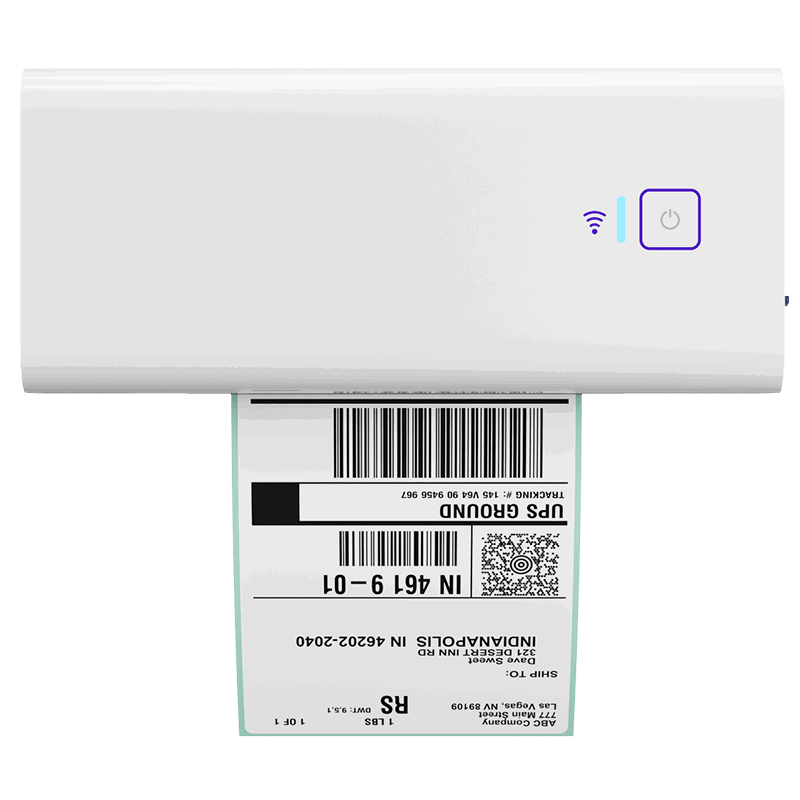
The Rollo Wireless Printer X1040 uses direct thermal technology — no ink, no toner, no cartridges — and prints one label per second. For thermal labels, poly mailers, and a digital shipping scale.
Why No Monthly Subscription Changes the Cost Equation
Most shipping platforms charge a flat monthly fee regardless of how much you ship. That model works against low-to-mid-volume sellers — you pay whether you ship 10 labels or 1,000.
Rollo Ship has no monthly subscription. The first 200 labels are free. After that, a small per-label service fee applies. Postage is always paid directly to the carrier. There is no business verification requirement and no minimum shipment volume.
That structure means your platform cost scales with your actual activity — not against it.
A Note for Canadian Sellers
Canadian sellers face the same surcharge stack as US sellers — with additional complexity layered on top. Canada Post rates vary by service tier, destination province, and package dimensions. UPS® Canada applies residential surcharges and zone-based pricing. Cross-border shipments add customs documentation, duties, and HS code requirements on top of domestic carrier costs.
Rollo Ship supports both US and Canadian sellers — compare Canada Post, UPS® Canada, FedEx Canada, and Purolator rates from one account. Canadian sellers shipping cross-border to the US can compare USPS, UPS®, and FedEx options for the US leg from the same dashboard.
Who This Article Is NOT For
This is not for sellers who ship a handful of packages per month with no growth plans. At very low volume, the per-shipment cost difference between carriers is real but small in absolute terms.
It is also not for sellers who already run DIM calculations on every package, compare rates across carriers before every label, and track average cost per zone monthly. If that is your current workflow, you already have the system this article is building toward.
This is for the seller who knows something is wrong with their shipping bill, suspects they are overpaying, but has not yet found where the leakage is or built the workflow to stop it.
A Simple Checklist for Catching Cost Traps Before You Print the Label
| Check | What to confirm before printing |
|---|---|
| DIM weight | Have you calculated the DIM weight for this package—not just weighed it? |
| Package size | Is the box larger than it needs to be? |
| Carrier comparison | Have you compared landed cost across at least two carriers? |
| Residential fee | Does your rate include the residential delivery surcharge? |
| Zone check | Is this a high-zone shipment where a different carrier may be cheaper? |
| Fuel surcharge | Is there a fuel adjustment applied to the current rate? |
| Label timing | Are you printing before or after all of the above are confirmed? |
The goal is not to make every label a ten-minute decision. It is to make sure the most common cost traps are caught before the label locks the shipment in.
Ready for a shipping workflow that scales without adding more chaos?
If your team is spending too much time on rate checks, label creation, and order handoffs, Rollo Ship can help bring those steps into one place. It is a practical next step for small teams that want more clarity, fewer repeated tasks, and a shipping process that feels easier to manage as order volume grows.

Why Shipping Feels More Expensive
The base rate is not the problem. The surcharge stack is.
Residential fees, fuel adjustments, DIM weight billing, and zone-based pricing all operate independently of the base rate, and they compound on top of each other on every label. Sellers who control shipping costs in 2026 are not necessarily the ones who negotiated the best base rates. They are the ones who see the full landed cost before printing and have a workflow that makes that comparison automatic, not manual.
Rollo Ship is a multi-carrier shipping platform that functions as a margin-optimization engine: compare landed costs across USPS, UPS®, FedEx, Purolator, and Canada Post before committing to a label. No monthly subscription. No carrier lock-in. The first 200 labels are free.
Follow Rollo on:
Frequently Asked Questions About Shipping Costs in 2026
📌 Q: Why are shipping costs rising in 2026 even when carrier rates appear unchanged?
💭 A: Carrier rate increases in 2026 are real but not the primary driver. The larger issue is the surcharge stack — residential delivery fees, fuel adjustments, dimensional weight pricing, and zone-based rates — that compounds on top of the base rate. Each can rise independently without a formal announcement, which is why the bill keeps growing even when the headline rate looks familiar.
📌 Q: What is shipping psychology and how does it affect what sellers pay?
💭 A: Shipping psychology refers to the behavioral patterns that cause sellers to systematically underestimate their true shipping cost. The most common are anchoring to the base rate, status quo bias toward a default carrier, and loss aversion misdirected toward visible tool fees rather than invisible surcharge leakage. Understanding these patterns is the first step to breaking them.
📌 Q: Why does my shipping bill keep going up even when I ship the same products to the same places?
💭 A: Base rates are only one part of your invoice. Fuel surcharges, residential delivery fees, and dimensional weight pricing all sit on top, and each can rise independently, without any formal rate increase announcement. Most sellers absorb the difference without knowing which line caused it.
📌 Q: What is the difference between a base rate and a landed cost in shipping?
💭 A: The base rate is what the carrier publishes before adjustments. The landed cost is what you actually pay after fuel surcharges, residential fees, DIM weight, and any other applicable charges are added. Landed cost is the number that matters for margin—and it is what Rollo Ship shows you before you print.
📌 Q: Do Canadian sellers face the same shipping surcharge issues as US sellers?
💭 A: Yes. Canada Post, UPS® Canada, and Purolator all apply fuel surcharges, residential fees, and dimensional weight pricing. Cross-border shipments add customs and duty complexity on top. Rollo Ship supports Canada Post, UPS® Canada, FedEx Canada, and Purolator from one account alongside US carriers.
📌 Q: Is there a shipping platform that shows multi-carrier rates without a monthly subscription?
💭 A: Rollo Ship has no monthly subscription. The first 200 labels are free. After that, a small per-label service fee applies starting at 5¢. Postage is paid directly to the carrier. No business verification or minimum shipment volume is required.
📌 Q: What is zone creep, and how does it affect shipping costs?
💭 A: Zone creep is the gradual rise in your average shipping zone as your customer base spreads geographically. Carriers price by distance from your origin—the farther the shipment, the higher the zone and the rate. As your brand grows, the average cost per label rises even without any carrier rate change.
📌 Q: How does dimensional weight pricing work?
💭 A: Dimensional weight is calculated by multiplying a package’s length, width, and height, then dividing by a carrier-specific DIM divisor. If the result exceeds actual weight, you are billed at the DIM weight. Sellers shipping lightweight products in large boxes—apparel, soft goods, art — are most commonly affected.
📌 Q: When should I start comparing rates across carriers instead of defaulting to one?
💭 A: As soon as shipping costs are affecting your margin, it is worth comparing. Carriers price residential fees, zones, and DIM weight differently—the cheapest carrier for one shipment may not be the cheapest for the next. Multi-carrier comparison at label purchase takes seconds and often surfaces a meaningful difference.
📌 Q: Do I need to buy a Rollo printer to use Rollo Ship?
💭 A: No. Rollo Ship works with any compatible printer. You do not need a Rollo printer to access carrier discounts, generate labels, compare rates, or connect your stores. The Rollo printer is an optional upgrade — not a requirement to use the platform.


